
· Photogrammetry
Metashape Processing Settings: What Each One Actually Does
A practitioner's guide to Agisoft Metashape processing settings: what each quality slider controls, why the tradeoffs matter, and three presets for real jobs.
Drone Mapping · Photogrammetry · LiDAR · GIS
The complete workflow — from flight planning to professional geospatial deliverables.
Recent
· Photogrammetry
A practitioner's guide to Agisoft Metashape processing settings: what each quality slider controls, why the tradeoffs matter, and three presets for real jobs.
· Photogrammetry
Image overlap drone mapping: 75/60 is the floor, not the target. Here's what fails when overlap is wrong and how to set photogrammetry overlap by job type.
· Software & Processing
In April 2026 WebODM forked the OpenDroneMap stack and renamed it — ODM became ODX, NodeODM became NodeODX. Which one you actually install, and why.
· Consumer Drone Mapping
WaypointMap vs Litchi Pilot vs DroneLink vs DJI Fly for automated Mini 4 Pro missions. KMZ workflow for RC 2, MSDK apps for Android.
· Photogrammetry
Orthomosaic export settings, point cloud formats, DEMs, coordinate systems — and how to package drone deliverables so clients can actually use them.
· Photogrammetry
The drone map doming effect causes systematic elevation errors up to 13 ft — and the orthomosaic looks fine. Here's how to detect, fix, and prevent it.
· Survey Accuracy
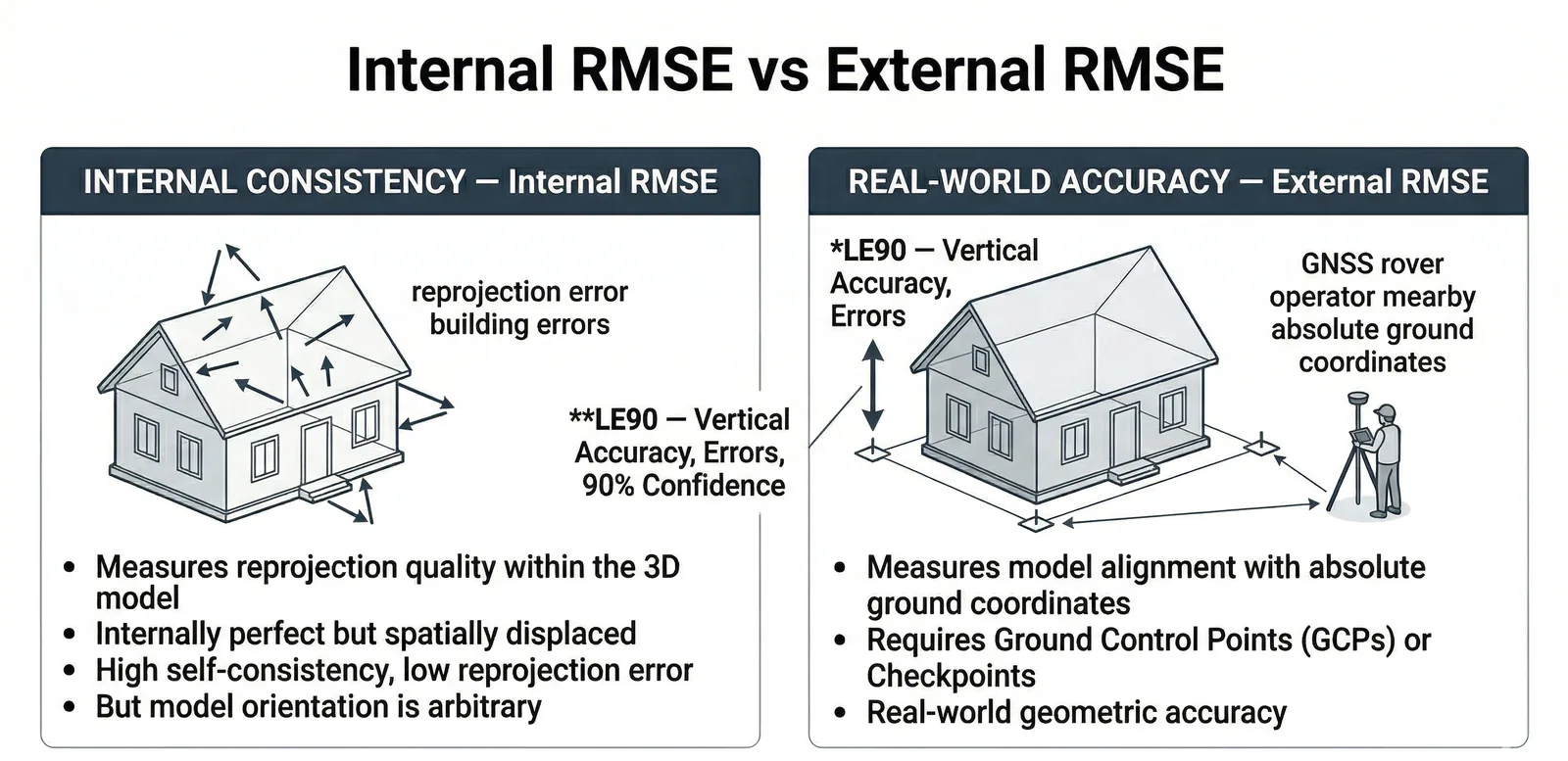
The drone mapping quality report looks reassuring — until a client finds 8-inch errors. Learn to read every Pix4D and Metashape number before delivery.
· Consumer Drone Mapping
Drone mapping flight parameters: GSD, overlap, altitude, speed. 80% frontal / 70% side minimums. Accuracy improves 11x from 60% to 80% overlap.
Series
6parts published
2parts published
1part published
6parts published
Frequently Asked
A well-executed drone survey delivers 2–5 cm horizontal accuracy with proper ground control. Vertical accuracy typically runs 2–3× worse than horizontal on nadir-only flights — adding an oblique pass closes most of that gap. The number that matters is checkpoint RMSE against independent surveyed points, not the GCP RMSE your software reports.
Read the full accuracy guide →It depends on the accuracy class your project requires. Direct RTK/PPK without GCPs reaches 2–5 cm horizontal under ideal conditions, but vertical bias and doming can blow up without independent control. For any engineering, construction, or formal accuracy claim, GCPs plus independent checkpoints are not optional.
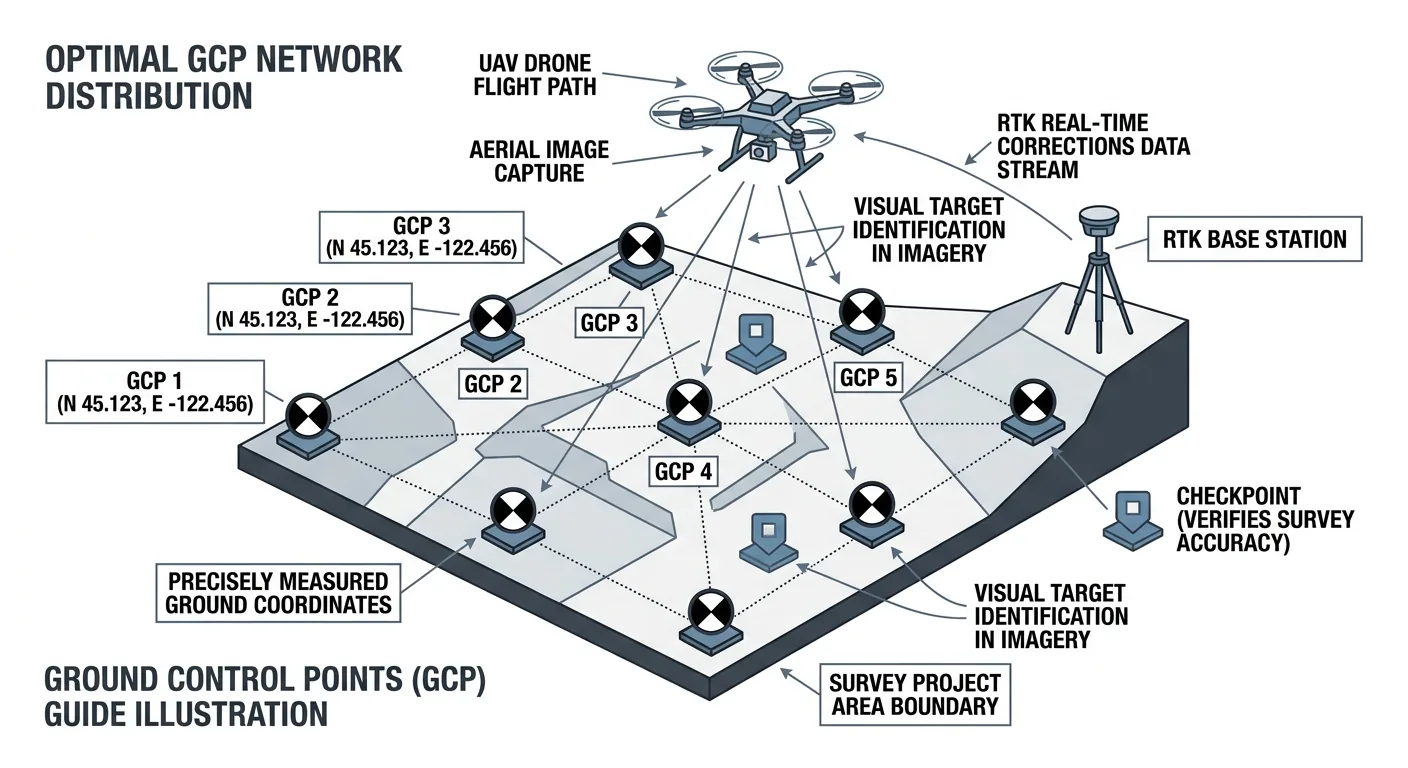
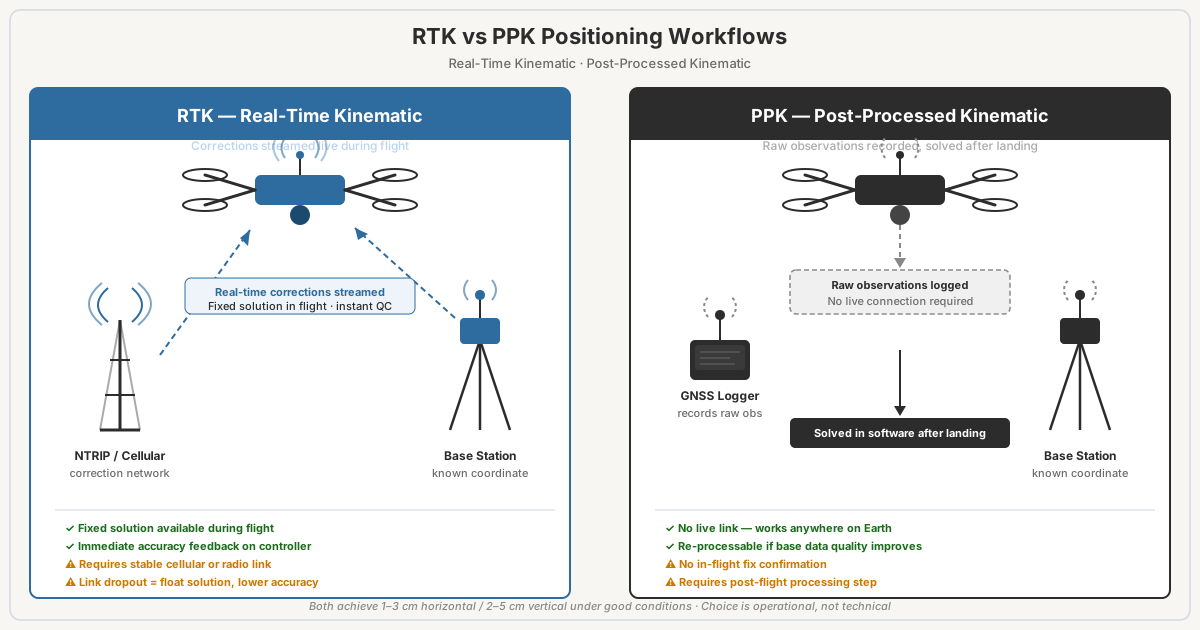
GCP placement and count guide →Both achieve comparable real-world accuracy when configured correctly. RTK gives real-time corrections in the field; PPK processes everything after the flight. PPK is more forgiving on remote or RF-noisy sites; RTK is faster when you have a reliable correction stream.
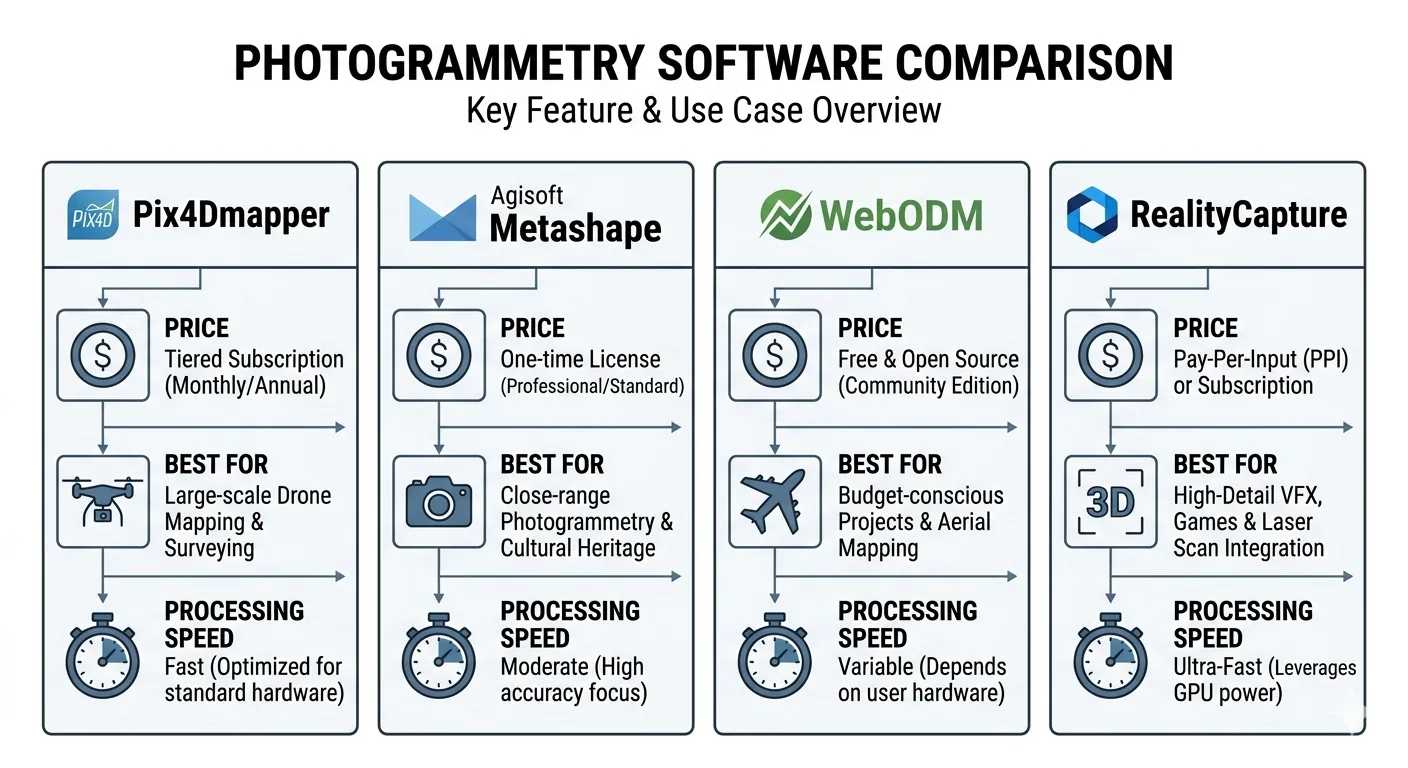
RTK vs PPK decision framework →Pix4D, Agisoft Metashape, WebODM, and RealityCapture each fit a different price point and workflow. WebODM is free and capable but needs hardware investment. Metashape is the most flexible for high-accuracy work. Pix4D excels at surveying templates. RealityCapture is fastest for very large datasets.
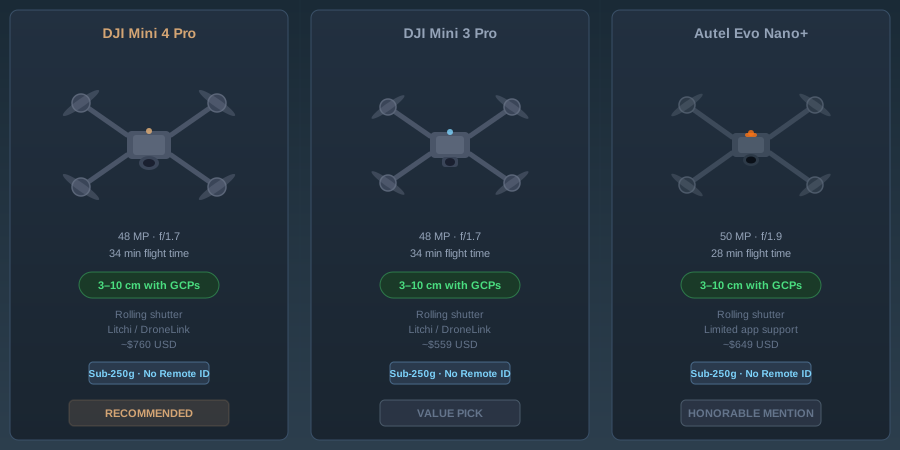
Vendor-neutral software comparison →For commercial work, a DJI Mavic 3 Enterprise or Phantom 4 RTK remains the practical default. For learning, side projects, and accuracy-tolerant work, a DJI Mini 4 Pro with proper GCPs delivers surprisingly good results — typically ±4–12 inches with disciplined workflow.
Consumer drone mapping buyer's guide →Colophon
Written by Eric — M.S. GIS, FAA Part 107, ten-plus years of geospatial work before drones were the interesting part of the job. Topics: photogrammetry, LiDAR, GCPs, RTK/PPK, coordinate systems, the software stack, and the parts of fieldwork that determine whether the deliverable holds up.
No sponsored posts. Vendor-neutral by default.