


You’re mapping a 15-mile pipeline corridor. Under Part 107 VLOS rules, you’re staging five crew positions spaced roughly 3 miles apart. Each position requires two pilots rotating through batteries—that’s 10 batteries total, 3 days in the field, and a logistics train that doubles your crew count just to keep things moving. The client wants RTK-grade orthomosaics. By day two, your crew is exhausted. Margins compress. Quality slips.
With BVLOS, that same corridor becomes one operator, one morning, one platform. A fixed-wing VTOL launches at dawn, flies the entire length, returns before lunch, lands itself in your truck bed. You downlink the imagery, process PPK positioning, and deliver the mosaic the next day. The technology exists now. The rules are almost there—and they’re coming in a way that changes everything about how mapping shops scale.
This is not theoretical. The FAA has published its proposed rule. The executive order is signed. By mid-2026, the final Part 108 could be live. Operators who understand what’s coming—who’ve already built the safety case, trained their crews, and positioned their equipment—will move faster than the market.
Here’s what you need to know, what you need to do, and how the math actually works on real projects.
The Regulatory Status: Where Things Stand Right Now
BVLOS operations are not yet legal under the standard rules. Part 107.31 prohibits flights beyond visual line of sight, with narrow exceptions. A waiver is your only legal option today.
The Current Waiver Regime
Since 2016, the FAA has issued 190 BVLOS waivers to 134 operators (as of October 2024). These waivers grant relief from Part 107.31 under specific conditions: defined corridors, crew composition, aircraft systems, and contingency procedures. Waiver holders include power utilities, agriculture operators, construction firms, and surveying companies.
A waiver costs time, not money. The DroneZone filing is free. The submission, stakeholder coordination, and FAA review take 60–90 days. Operators with the foundation—proven DAA, crew training docs, contingency maps—routinely succeed.
The Proposed Rule: Part 108
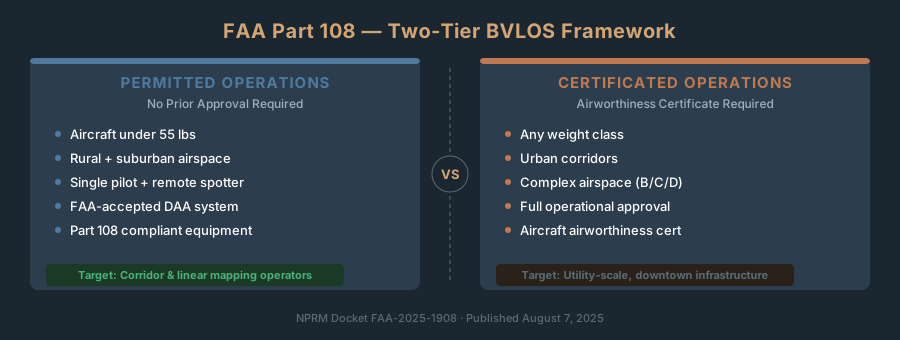
On August 7, 2025, the FAA published an NPRM (Notice of Proposed Rulemaking) under docket FAA-2025-1908, titled “Normalizing UAS BVLOS Operations.” The rule proposes a new Part 108 that splits BVLOS operations into two tiers:
Permitted Operations — Smaller aircraft (under 55 pounds), rural or suburban terrain, simpler operational envelopes. No prior approval required once you’re Part 108–compliant. Think of it as the “simplified BVLOS” tier.
Certificated Operations — Urban corridors, heavier aircraft, complex airspace, higher risk. Requires an airworthiness certificate and operational approval. This is for the power utility surveying downtown infrastructure.
For mapping professionals, the Permitted tier is the one that matters. It means you can perform BVLOS corridor and linear mapping without needing a waiver for every project.
The Timeline: When Rules Become Reality
On June 6, 2025, the White House issued an executive order: “Unleashing American Drone Dominance.” It set a 240-day deadline for the FAA to finalize the UAS BVLOS rule. That deadline falls in mid-March 2026—adjusted for the 43-day government shutdown—with the final rule expected by mid-2026.
The final rule isn’t published yet. The regulatory machinery is moving. Industry comment period closed in November 2025. The FAA is now reconciling comments. Assume a final Part 108 rule by mid-2026—with early compliance pathways available before formal adoption.
What this means for you: Prepare now. Equipment orders, crew training, and safety case documentation take 8–12 weeks. You’ll be operational months before competitors even read the final rule.
Part 108 for Mapping Operators: The Permitted Tier Advantage
The proposed Part 108 Permitted tier is purpose-built for the kind of work mapping professionals do. Let’s break what it requires and what it enables.
Aircraft and Payload Limits
Maximum takeoff weight: 55 pounds. This covers most mid-size quadcopters and fixed-wing platforms designed for surveying. The DJI Matrice 3D, the Autel Dragonfish, and most professional VTOL systems fall comfortably in this envelope.
Allowed airspace: Rural and suburban areas (Class G airspace preferred, but not required). Urban canyon operations stay in the Certificated tier—for now. That’s fine for linear infrastructure mapping: power lines, pipelines, roads, and rail corridors are mostly in rural or suburban environments.
Operating requirements: Single pilot + spotter, or approved remote-ready crew. Part 108 allows remote visual observers (via video feed)—a major shift from Part 107 rules. Your on-site crew shrinks immediately.
What You Don’t Need Under Part 108
- No waiver application for every project (once your operation is Part 108–compliant).
- No airspace approval for most rural/suburban corridors.
- No case-by-case certification of your detect-and-avoid system (you adopt an FAA-accepted standard).
- No weather-contingency approval letter for each flight (you follow published operational minimums).
What You Still Need
Remote ID. Standard broadcast Remote ID module. Prohibited aircraft Remote ID (hidden in the signal) is not permitted for Part 108 BVLOS.
Detect and avoid (DAA). Onboard sensors (ADS-B in, sense-and-avoid radar, optical) or airborne DAA service provider coordination. The FAA will accept vendor-certified systems from DJI, Autel, Skydio, and others. Not all systems qualify yet—certification is still rolling out.
Crew training and documentation. Pilot and spotter training in BVLOS procedures, emergency response, DAA operation. You need a training document—the FAA will ask for it. (Details below in the waiver section.)
Insurance. BVLOS requires $5–10M per occurrence coverage. Standard commercial drone policies max out at $1–5M. You’ll need an aviation-specialist insurer.
The Equipment Landscape: What’s Ready Now
Three categories dominate: quadcopter, fixed-wing VTOL, and fixed-wing. For mapping corridors, choose based on corridor length, terrain, and accuracy tier.
| Platform | Type | Price | Max Flight Time | Max Range | Payload | Best For |
|---|---|---|---|---|---|---|
| DJI Matrice 3D (+ Dock 2) | Quadcopter | $14,699 | 50 min | ~10 km | 1 kg | 5–10 km corridors, RTK post-processing |
| DJI Matrice 3TD (+ Dock 2) | Quadcopter | $16,569 | 50 min | ~10 km | 1 kg | Same + thermal overlay (pipeline leak detection) |
| WingtraOne Gen II | Fixed-wing VTOL | ~$12,000–20,000 | 59 min | ~10 km | 0.8 kg | 5–15 km corridors, high-accuracy photogrammetry |
| Autel Dragonfish | Fixed-wing VTOL | ~$99,000 | 179 min | 30 km | 2.7 kg | 20–50+ mile runs, heavy wind, surveillance hybrid |
| Iris Automation Casia 360 | Enterprise VTOL | Quote | 120+ min | 50+ km | 5+ kg | Multi-hundred-mile surveys, military/utility scale |
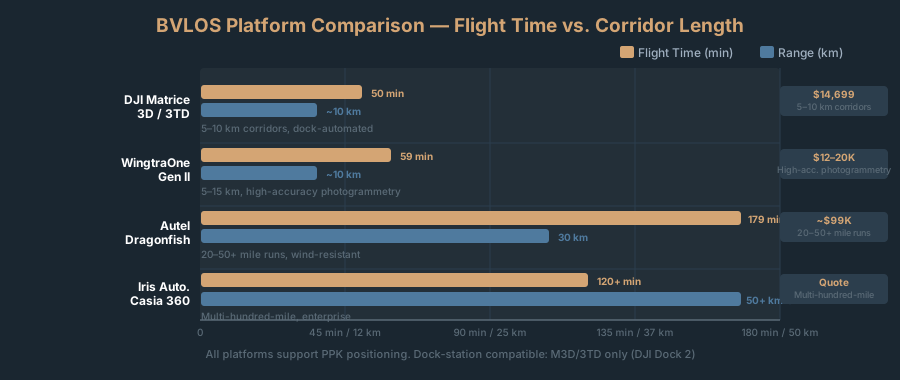
Real-world math: Under 10 miles? Matrice 3D + dock. 10–30 miles? WingtraOne or Dragonfish cuts flight time 30–50%. Over 30 miles? Dragonfish pays for itself in one survey—one 179-minute flight replaces six flights, three staging points, and eight battery swaps.
The dock station (DJI Dock 2, ~$10,000) is infrastructure, not luxury. Automated battery swap and trickle charging eliminate crew standby time. Queue back-to-back flights while you process data in parallel.
How BVLOS Changes Your Mapping Workflows
BVLOS doesn’t change what you deliver—orthomosaics, DTMs, point clouds. It changes how fast you collect the raw data and how you structure the flight plan.
Coverage Math: BVLOS vs. VLOS
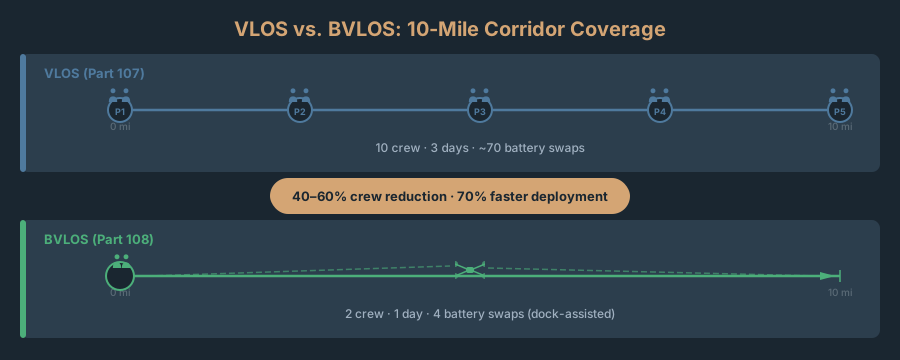
A 10-mile highway corridor. Standard VLOS workflow (2 km range per position):
- Positions needed: 5 (roughly 2 km apart)
- Crew per position: 2 pilots (rotating batteries)
- Total crew: 10
- Flight time per position: ~30 minutes flying, 60 minutes ground turnaround
- Days required: 3
- Battery swaps: ~70
Same corridor with BVLOS on a Matrice 3D:
- Crew: 1 pilot, 1 spotter (can be remote)
- Flight time: 4 flights of 45 minutes each (two 5-mile legs per flight)
- Days required: 1
- Battery swaps: 4 (dock-assisted, minimal intervention)
The math: 40–60% crew reduction, 70% faster deployment. On an $8,000 project, save $3,200–7,200 in labor. On a $50,000 utility survey, save $20,000+.
GCP Strategy at Extended Range
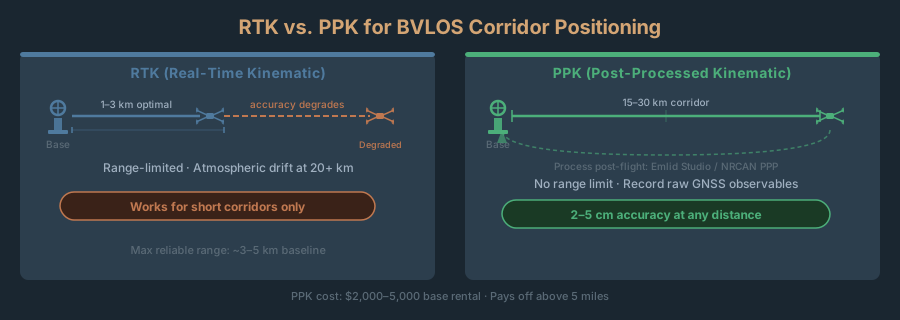
BVLOS exposes a tension in positioning strategy. At 2 km range (VLOS), you’re close enough to RTK base station corrections that you can achieve 2–5 cm XY accuracy without ground control points. At 20+ km range (BVLOS), the RTK baseline becomes unreliable—atmospheric interference and signal fade compound.
The fix: PPK (Post-Processed Kinematic) positioning.
PPK breaks RTK’s baseline distance limit. Fly with high-grade GNSS (built into Matrice 3D, Dragonfish, X10), record raw observables, process post-flight against a stationary base or NRCAN PPP service. Accuracy stays 2–5 cm. Range is unlimited.
For a 15-mile corridor:
- Base station placement: 1 location, midpoint preferred. If corridor is 8+ miles from base, add a second station.
- GCP placement: 1 GCP every 200–300 meters, alternating sides. 15 miles = ~50–75 GCPs. More than VLOS, yes—but you place them once while the drone flies. With VLOS you’d do this three times.
- Processing: Import observables into Emlid Studio, tie to base station(s), bundle adjust with GCPs. Result: 2–4 cm horizontal, 3–6 cm vertical.
PPK cost: $2,000–5,000 for base station rental. Eliminates multiple staging crews. Math wins above 5 miles.
Fixed-Wing VTOL for Long Corridors
Over 20 miles? Switch platforms. A fixed-wing VTOL (WingtraOne, Dragonfish) cuts flight count in half.
- 15 miles on Matrice 3D: 4 flights, ~180 minutes, 2–3 days
- 15 miles on Dragonfish: 1–2 flights, 90–120 minutes, 1 day
- 30 miles on Dragonfish: 1 flight, 179 minutes, 1 day
Dragonfish is expensive upfront. But on routine 20-mile-plus surveys—utility monitoring, pipeline inspections, linear infrastructure—it cuts annual flight hours by 300–400. That’s 4–5 FTE field operators’ worth of capacity.
The Waiver Path: Getting BVLOS Today (Before Part 108 Is Final)
If you need BVLOS capability before the final Part 108 rule, a Part 107.31 waiver is your option. The process is standardized, and operators who follow the template typically succeed.
The DroneZone Submission
File your waiver application through the FAA’s DroneZone portal. No fee. You’ll submit FAA Form 7711-2 and supporting documentation.
Required elements:
-
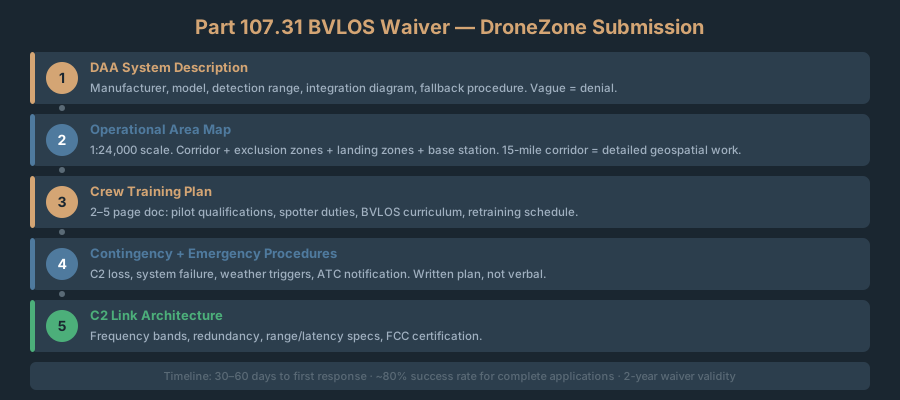
Detect and Avoid System Description. This is the hardest section. The FAA wants a detailed explanation of how your aircraft sees other traffic and avoids it. “We will use ADS-B in and pilot vigilance” is too vague. You need:
- System model, manufacturer, and specification (e.g., Garmin GDL 82 ADS-B receiver, 500+ watt power, 360-degree antenna coverage).
- Performance envelope (detection range, target sizes, latency).
- Integration with your autopilot/flight control system.
- Fallback procedures if DAA fails (return to last known position, land in designated zone).
Common denial: Vague DAA description. The FAA needs spec sheets and integration diagrams—not hand-waving.
-
Operational Area Map. 1:24,000 scale minimum. Show:
- Flight corridor (primary area)
- Exclusion zones (airports, helipads, restricted airspace)
- Designated landing zones (multiple options, with coordinates)
- Base station location
Common denial: Map lacks detail. Include individual landmarks, nearby airports, specific coordinates. 15-mile corridor = 15 miles of detailed geospatial work expected.
-
Crew Training Plan. 2–5 page document covering:
- Pilot qualifications and Part 107 cert
- Spotter qualifications and duties
- BVLOS curriculum (DAA, contingencies, radio protocol)
- Retraining schedule and proficiency checks
Common denial: No formal plan. “We’ll brief the pilot” fails. Write a document anyone could follow.
-
Contingency and Emergency Procedures. Written plan for:
- C2 link loss and recovery
- Aircraft system failure and safe landing
- Medical emergency (pilot incapacitation)
- Weather deterioration triggers
- Authority notification (ATC, stakeholders)
-
C2 Link Architecture. How control signals and telemetry flow. Specify:
- Frequency bands (Part 107 typical: 2.4 GHz Wi-Fi 5/6)
- Redundancy (backup frequency? alternative method?)
- Range and latency specs
- Regulatory cert (FCC Part 15, etc.)
Timeline and Success Rates
- Submission to first response: 30–60 days.
- Success rate: ~80% for well-prepared applications. Most denials are procedural (missing documentation or vague system descriptions), not technical.
- Revision and resubmission: If you get a denial, file a revised application addressing specific FAA comments. This typically succeeds.
- Waiver validity: Usually 2 years, can be renewed.
What Airspace Matters
Class G airspace (uncontrolled): Best case. Maximum flexibility. Most rural and suburban corridors are Class G. The FAA rarely denies Class G waivers with solid DAA and contingency plans.
Class D, E, C, B airspace: Requires ATC coordination (tower, center, approach). Not automatic denial, but adds layers and constraints. Some facilities approve Class D/E BVLOS with limits: operating hours, altitude floors, notification.
Class A airspace: Prohibited for BVLOS (FL180+, irrelevant for mapping).
For mapping: Class G is standard. Near a busy airport or metro area? Expect Class D/E coordination delays.
Insurance and Liability: The Threshold Problem
BVLOS exposes higher liability. Insurance follows.
Current VLOS Insurance
Standard commercial drone insurance (Part 107 VLOS) covers:
- General liability: $1–5M per occurrence, $2–10M aggregate
- Coverage: Bodily injury, property damage, personal injury
- Exclusions: Intentional acts, criminal liability, high-risk ops
- Cost: $500–2,000/year (varies by fleet size and claims history)
BVLOS Insurance Requirements
BVLOS = larger aircraft, longer distances, less operator proximity = higher risk. Pricing reflects that.
- General liability: $5–10M per occurrence (utility-scale work: $10–20M+)
- Professional liability: $2–5M (data delivery errors, surveying claims)
- Coverage: Same areas as VLOS, higher limits
- Exclusions: Stricter on airspace coordination, crew training, equipment maintenance
- Cost: $2,500–8,000/year (fleet size, waiver status, claims history)
Finding an Insurer
Standard brokers rarely write BVLOS. Find an aviation specialist. AIG, Starr Aviation, Global Aerospace, regional carriers all write BVLOS UAS. They’ll ask for:
- Waiver proof (or Part 108 compliance once final)
- Crew training docs
- Safety management system (procedures, maintenance logs, incident reports)
- Equipment manifest and maintenance schedule
Timeline: 4–8 weeks to quote and bind. Start before flying, not after.
Cost-Benefit Math
BVLOS cuts field time 50%. Insurance adds $1,500–4,000/year. One 20-mile survey at $15,000–25,000 covers the delta—if you fly BVLOS 3–4 times yearly.
What to Do Right Now
The final Part 108 rule is weeks away. Here’s the preparation timeline:
Immediate (This Month)
-
Inventory your equipment and GNSS.
- Which platforms have standard Remote ID (not prohibited Remote ID)?
- Do you own survey-grade GNSS base station, or will you rent?
- How many batteries fit your dock-station workflow?
-
Start insurance quotes now.
- Contact aviation brokers. Ask about BVLOS readiness and preliminary underwriting. Don’t wait for waiver approval—underwriters need lead time.
-
Read FAA docket FAA-2025-1908.
- Go to regulations.gov, find the NPRM and final rule. Understand Permitted vs. Certificated tiers and what applies to your ops.
Short Term (Next 60 Days)
-
Plan a waiver application (if you need BVLOS before Part 108 closes).
- Pick a pilot project: 5–15 mile corridor, Class G, minimal stakeholder work.
- Gather your operational area map and existing safety procedures (training, contingency).
- Draft DAA system description and submit to DroneZone.
-
Dock-station procurement.
- DJI Dock 2: ~$10,000, 4–6 week lead time.
- Check power: dock needs 100–240V AC, 50/60 Hz (verify amperage with your electrician).
-
Build crew training curriculum.
- BVLOS rules and limitations
- DAA system operation and manual override
- Spotter responsibilities
- Radio protocol and ATC interaction
- Emergency procedures
- Plan 1–2 days in-person training per crew member.
Medium Term (Next 6 Months)
-
Execute your first BVLOS flight.
- Waiver path: launch under waiver authority.
- Part 108 final: certify as compliant, launch Permitted-tier flight.
-
Test real workflows.
- Run 5–10 mile corridor, compare PPK vs. RTK accuracy and cost.
- Log crew time, battery performance, weather delays.
- Refine GCP placement based on actual data.
-
Document safety systems.
- Incident reporting, maintenance logs, crew training records, equipment inventory.
- Insurers will ask for this. It also positions you ahead of competitors.
Frequently Asked Questions
Q: Once Part 108 is final, can I ignore Part 107?
A: No. Part 107 and Part 108 coexist. Part 107 stays the standard for VLOS. Existing waivers remain valid until operators transition to Part 108. VLOS flying = Part 107. BVLOS flying = Part 108. Your Part 107 license remains foundational.
Q: Is RTK still viable for BVLOS, or does PPK replace it?
A: PPK is standard for long corridors (>5 km from base). RTK works if you’re 1–3 km from base or in confined areas. For 10–20 km utility work, PPK wins. High-end RTK networks (NTRIP, multiple bases) stretch range. Math favors PPK on linear infrastructure.
Q: Can I use a remote spotter under Part 108?
A: Yes. Part 108 allows remote visual observers via video feed, subject to operational rules. Your DAA and C2 must support low-latency video (<200 ms). Shrinks on-site crew, but you need a second person monitoring the feed. Two humans required: one flying, one observing remotely.
Q: What happens to my current waiver when Part 108 finalizes?
A: FAA guidance isn’t final yet. Existing waivers likely remain valid until expiration (typically 2 years). New BVLOS ops should follow Part 108, not seek new waivers. Current waiver holders can continue under their waiver until renewal, then transition to Part 108.
Q: Do I need a surveying license to deliver BVLOS-collected mapping data?
A: This depends entirely on the deliverable and your state’s regulations—not on the method of data collection. If you’re delivering a georeferenced orthomosaic or point cloud that’s used for survey-grade applications (boundary determinations, volumetric calculations, infrastructure design), your state surveying board may require licensure. BVLOS doesn’t change this. See Where the Legal Lines Are for a detailed breakdown of state regulations.
Q: Can I fly BVLOS over populated areas under Part 108?
A: Not Permitted tier. Permitted = rural and suburban only. Urban BVLOS (populated areas) needs Certificated tier—aircraft certification and operational approval. Heavier regulatory lift. Most urban mapping stays VLOS or uses helicopters.
Q: How does BVLOS change my client contracts?
A: Deliverables stay the same, but your risk profile shifts. Insurance requirements increase, crew training becomes audit-able. In contracts, specify: “BVLOS operations under FAA waiver [#] or Part 108 authorization.” Detail positioning method (PPK vs. RTK), accuracy tier, limitations. Data’s the same, regulatory framework is different. Document everything.
Q: Will a drone I buy today be Part 108–compliant?
A: Probably, if it’s current from DJI, Autel, or Skydio. Manufacturers are building for Part 108—Remote ID, DAA readiness, documentation. But compliance isn’t binary; it depends on configuration, sensors, and operational docs. Matrice 3D is nearly out-of-box compliant. Custom fixed-wing builds are not. Ask the manufacturer: “Certified for Part 108 DAA ops? What documentation do you provide?”
BVLOS is happening now, with final rules by mid-2026. For mapping professionals, it solves a real problem: collapses field time from days to hours on linear infrastructure. 40–60% labor savings. 70% faster data collection. Not marginal. Transformational.
Three paths:
-
File a Part 107.31 waiver now. Predictable process, high success rate, flying in 60–90 days.
-
Prepare for Part 108 compliance. Audit equipment (Remote ID, GNSS, DAA), lock in insurance, build crew training docs. Transition in weeks once the rule lands.
-
Stay VLOS. If volume doesn’t justify the regulatory work. But watch competitors undercut you on corridor projects.
Pick based on your project pipeline and risk tolerance. Either way—move in the next 60–90 days. Operators who prepare now own this market. Operators who wait catch up from behind.
References and Further Reading
- Federal Register, NPRM “Normalizing UAS BVLOS Operations,” Docket FAA-2025-1908 (published August 7, 2025). Available at regulations.gov.
- Executive Order: “Unleashing American Drone Dominance,” June 6, 2025.
- FAA Part 107 Waiver Guidance, available at faa.gov/uas.
- FAA DroneZone Portal, uas-faa.opendata.arcgis.com (waiver application and tracking).
Related AeroCartwright Articles
- Where the Legal Lines Are: Drone Mapping vs. Surveying
- RTK vs. PPK: Choosing Your Positioning Tier
- Drone Survey Positioning Tiers: Accuracy for Your Project
- GSD Calculator
Legal Note: BVLOS doesn’t change the mapping-vs-surveying legal framework. State surveying license requirements apply to BVLOS deliverables the same way they apply to VLOS deliverables—the method of data collection doesn’t affect the regulatory classification of the output. See Where the Legal Lines Are for details on state regulations and when a professional surveying license is required.