



A general contractor called last month about their 14-acre mixed-use development. No orthomosaics. No printed reports. They want data flowing into their Autodesk Tandem dashboard—visual reality updated weekly, overlaid against the BIM model, flagging deviations from schedule or design automatically. Weekly flights for 18 months. They need someone who speaks coordinate systems, data formats, BIM workflows. They’re offering $4,500/month.
Digital twin work. High-end construction drone services. Most operators don’t know it exists, much less how to sell or deliver it.
Digital twins have been jargon for five years. Now they’re breaking into mainstream construction procurement. GCs, owners, facility managers demand them. The barrier is understanding data flow, platforms, required accuracy, and how to price recurring revenue instead of per-flight gigs — not the drone itself.
One 12-month digital twin client = $36,000–180,000 recurring income. Beats 50 one-off flights at inflated rates.
Here’s what a digital twin is, what drone data feeds it, and how to win these contracts.
What a Digital Twin Actually Is (For Drone Operators)
Skip the academic definition. Here’s what matters operationally:
A digital twin is a continuously updated digital counterpart of a physical asset—a building or site. Not just a 3D model. A data layer constantly synced with real-world conditions.
BIM provides design intent—what should exist. Digital twins answer: what actually exists right now?
Three overlapping data worlds in construction:
- Design BIM: IFC files from architect/engineer. Schedules, specs, coordinate systems, hierarchies.
- Reality data: Weekly drone captures—orthomosaics, point clouds, 3D meshes. Current site state.
- Operational sensors: IoT feeds—temperature, occupancy, vibration, energy. What the building is doing.
Digital twins integrate all three. BIM = what should happen. Reality = what happened. Sensors = how it performs. Automated detection: foundation poured early, frame shifted 4 inches from design, exterior ahead of interior MEP—flagged instantly in a dashboard.
Standards that matter:
- ISO 23247 — Digital Twin framework (manufacturing, extended to construction)
- buildingSMART IFC 4.3 — Building information exchange schema
- OGC 3D Tiles 1.1 — Stream 3D geospatial data to web/mobile
Don’t memorize them. But know: platforms expect specific formats. Orthomosaics = GeoTIFF. Point clouds = LAS/LAZ. IFC files = correct CRS. Meshes = glTF/OBJ with georeferencing.
Wrong format or CRS? Data won’t integrate. Build delays while IT troubleshoots. Contracts end here.
What Drone Data Feeds Into a Digital Twin
Not all drone deliverables carry equal value in a digital twin. There’s a hierarchy.
Tier 1: Visual Progress Documentation (Basic, $2,500–4,000/month)
Weekly orthomosaics and DSMs. No integration. Clients overlay manually against design, use for progress photos, calculate volumes in spreadsheets.
Deliverables:
- Orthomosaic (GeoTIFF, 2–5 cm GSD) — georeferenced aerial image, ortho-corrected
- DSM (GeoTIFF) — digital surface model, elevation at every pixel. Grading and volume calcs.
Value: Visual progress proof. Hand-measure areas and elevations. 40–60% fewer site walks.
Problem: Manual process. File management fatigue.
Tier 2: Progress Intelligence (Mid-tier, $4,500–8,000/month)
Orthomosaics + DSM + 3D textured mesh + pre-built reports with BIM overlay. Platform (DroneDeploy, Bentley, etc.) auto-aligns data against design, highlights deviations, generates reports.
Additional deliverables:
- 3D textured mesh (glTF or OBJ) — photogrammetric mesh with RGB baked in. Spatial context beyond ortho.
- Automatic BIM comparison — reality data registered against design BIM, deviation from schedule calculated.
- Variance reports — structured narratives: planned vs. actual, risk callouts.
Value: Intelligence, not just data. Automated reporting shrinks PM time. Deviations surface early.
Problem: Requires skilled CRS alignment, BIM integration, QA. Most operators can’t execute this.
Tier 3: Full Digital Twin Integration (Premium, $8,000–15,000+/month)
Orthomosaics + 3D mesh + dense point clouds + scan-to-BIM as-built models + optional LiDAR + IoT feeds in one platform (Tandem, iTwin, Potree).
Complete deliverables:
- Dense point cloud (LAS/LAZ, 500+ pts/m2) — georeferenced to project CRS. Clash detection, as-built geometry, volume validation.
- 3D Gaussian Splats (3DTiles) — emerging high-fidelity format. DJI Terra 5.0 exports native. Immersive context, smaller files than meshes.
- IFC as-built model (scan-to-BIM) — point cloud processed into IFC representing actual structural and MEP locations. Highest value. Requires BIM expertise and scanning photogrammetry settings.
- IoT integration — live sensor feeds (temperature, air quality, structural movement) in one dashboard with visual data.
Value: Complete operational digital twin. Design + reality + performance in one tool. As-built IFC feeds directly into FM at closeout. Conflicts detected before schedule impact.
Problem: Needs LiDAR ($8k–40k), advanced photogrammetry knowledge, BIM authoring, integration expertise. Only 12–15% of operators reach here.
Why hierarchy matters for pricing:
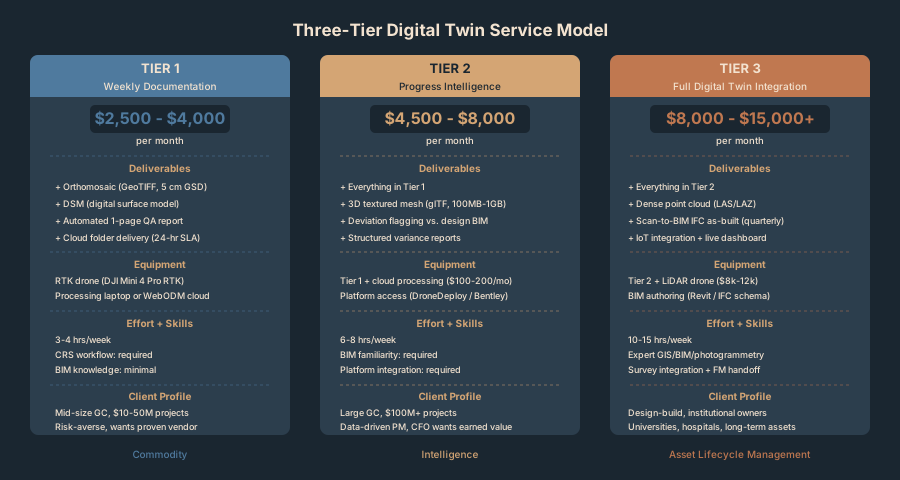
Tier 1 = commodity. Tier 2 = intelligence. Tier 3 = asset lifecycle management.
A GC pays 10x more to avoid a $500K clash miss than to get progress photos. Digital twin pricing = risk mitigation, not file delivery.
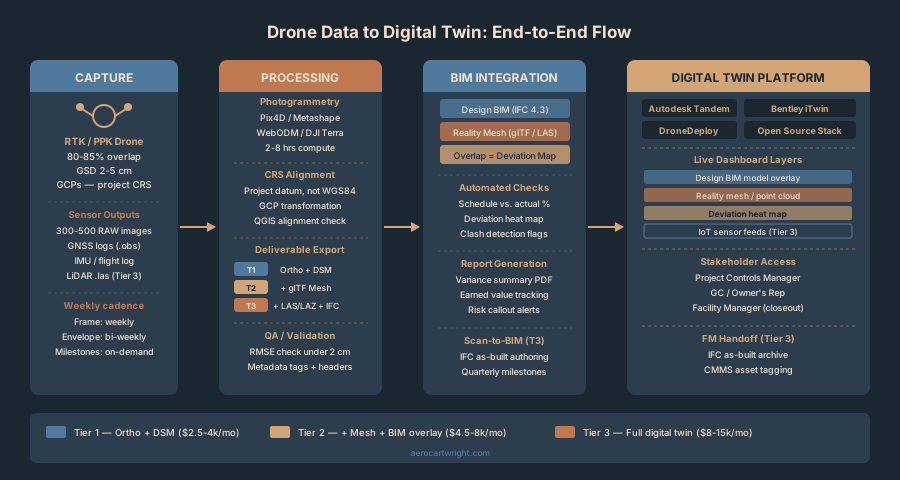
Capture Frequency and Accuracy Requirements
One week of delay costs $50K–300K in crew overhead and equipment rental. High stakes = more data demand.
Standard capture cadence:
| Phase | Frequency | Reason |
|---|---|---|
| Earthwork/Grading | Weekly (bi-weekly OK) | Volume calculations determine payment. Equipment operators need visual proof of progress. |
| Structural Frame | Weekly | Schedule is tightest. Deviation from plan is immediate and expensive. |
| Envelope | Bi-weekly | Progress is slower; visual changes are larger. |
| Interior/Finish | Monthly | Progress is interior-only. External progress monitoring becomes visual only. |
| Milestone events | Event-triggered (4–6 per project) | Foundation pour, frame completion, topping out, occupancy. Clients want hi-res captures at these moments. |
Typical 12–18 month project: 52–72 regular flights + 4–6 milestone captures = 56–78 flights.
Tier 2 contract (ortho + DSM + mesh + reports): 52 flights over 12 months = 12 x $5K/month = $60K. One-off pricing for same volume = $250–400/flight = $13K–20.8K total. Recurring wins.
Accuracy requirements by use case:
| Deliverable | Accuracy Requirement | Why |
|---|---|---|
| Visual progress tracking | 1–3 cm horizontal, 2–5 cm vertical | Tolerances are coarse. User eyes the deviation. |
| Earthwork volume certification | +/-2 cm vertical (critical) | Invoicing. Client is paying by the cubic yard. +/-2 cm on a 50-foot grading pad introduces ~3% volume error. Acceptable. Tighter is expensive. |
| Structural as-built measurement | +/-1 cm horizontal, +/-1.5 cm vertical | Design conflicts must be visible. A 2-inch shift in a column location can trap MEP runs. |
| Scan-to-BIM IFC production | +/-0.5 cm horizontal, +/-1 cm vertical | Point cloud must be dimensionally reliable enough to author geometry-correct IFC objects. |
The CRS problem:
Number one failure point in digital twin projects. Not accuracy—CRS alignment.
Every project uses project-specific coordinates. Civil engineer sets local origin, bearing north, project boundary, elevations relative to site benchmark (often assumed datum, not NAVD88). BIM sits in this CRS.
Your drone data defaults to WGS84 or different State Plane zone. Don’t transform it into project CRS? Reality dataset offsets by meters—or degrees—from design.
Site engineer spent two days setting the datum with total station and GPS base. Misaligned data = worthless. Not a technical error. Workflow error. Unforgiving.
How to prevent it:
- Get project CRS from civil engineer’s survey report or BIM metadata. Example: “Local Grid NAD83 2011 Ohio State Plane North” or “Assumed Datum, Monument A.”
- Establish one accurate GCP in that CRS. Surveyor shoots it RTK, 2 cm accuracy.
- Process drone data with that GCP. Photogrammetry software (Pix4D, Metashape, WebODM) transforms the model into project CRS.
- Include CRS definition in deliverable metadata. GeoTIFF headers, LAS headers, GeoJSON all support CRS tags.
One missed transformation = six months of unusable data. Contractors zero the contract and hire someone else. This is how operators lose clients.
Digital Twin Platforms: Where the Data Goes
A digital twin is only as good as its platform. Know which platforms exist, what they cost, and what data they accept.
| Platform | Cost (April 2026) | Best For | Data Formats Accepted |
|---|---|---|---|
| Autodesk Tandem | $295/month per user (3-user minimum) or $3,540/year | Construction + FM integration, tight BIM alignment, API-rich | IFC, glTF, LAS, orthomosaic GeoTIFF, point cloud COG |
| Bentley iTwin | $199–499/month (Standard/Premium tier) | Design-to-ops continuity, advanced analytics, iModel (Bentley proprietary) | iModel, IFC, 3D Tiles, LAS, orthomosaic GeoTIFF |
| DroneDeploy | $4,188/year minimum (Construction package, custom pricing) | Drone-native, flight automation, easy integration | Orthomosaic GeoTIFF, point cloud, DSM, custom report templates |
| Trimble Connect | $12.99/user/month (Business tier) | Small-to-mid contractors, file management, basic collaboration | IFC, PDFs, models, orthomosaic GeoTIFF |
| Pix4Dmapper | $332.50/mo or $399–$479.88/yr annual subscription (as of 2026-04-22) | Desktop-grade processing, batch workflows, point cloud classification | LAS/LAZ, GeoTIFF, IFC export via plugins |
| Open Source Stack | Free (Potree + Cesium ion free tier + WebODM + QGIS) | Budget-conscious, self-hosted, maximum control | LAS/LAZ, GeoTIFF, 3D Tiles (open standards) |
Client decision factors:
- BIM integration. Tandem and iTwin sync directly with Revit/OpenBuildings. DroneDeploy and Trimble are lighter.
- User seat cost. 20 project managers needing access? Tandem/iTwin per-seat pricing balloons. DroneDeploy scales better.
- API access. Tandem = robust REST APIs for custom integrations. iTwin has APIs but steep curve. DroneDeploy = simpler, less deep.
- Self-hosting. Some contractors want on-premise. Only open-source (Potree + local) or custom builds work.
For initial contracts: assume Autodesk Tandem (most GCs) or DroneDeploy (mid-market). Position accordingly.
The Three-Tier Service Model
How to price and structure digital twin work so you can deliver consistently.
Tier 1: Weekly Documentation ($2,500–4,000/month)
Deliverables:
- 1 flight/week (same day/time, 90-min weather window)
- Orthomosaic (5 cm GSD standard)
- DSM (bare earth if requested, surface standard)
- GeoTIFF to client cloud folder (Drive, Dropbox, S3)
- 24-hour processing turnaround
- Automated report (1 page): date, cloud %, GSD, GCP count, RMSE
Equipment:
- RTK drone (DJI Mini 4 Pro w/ RTK, or Mavic 3T)
- Processing laptop (8-core, 16GB RAM+) or WebODM cloud ($20–40/month)
- GCP kit if +/-2cm vertical required (1 surveyed control point per 10 acres)
Effort:
- 3–4 hours/week (flight, processing, QA, delivery)
- Minimal BIM knowledge
- CRS knowledge critical—use project datum, not UTM
Win this by:
- Emphasizing consistency and reliability
- Offering weekend/holiday flights
- Mobile-friendly data portal (tablet review in field)
- Undercut one-off pricing (operators charge $500/flight; position Tier 1 as “half that, recurring”)
Client profile: Mid-size GC, $10–50M budgets, 2–3 concurrent sites, risk-averse on tech. Wants proven vendor, not bleeding edge.
Tier 2: Progress Intelligence ($4,500–8,000/month)
Deliverables:
- Tier 1 + weekly 3D textured mesh (glTF, ~100 MB–1 GB/flight)
- Automatic deviation flagging: schedule vs. reality overlay
- Structured variance reports: planned vs. actual, 2–3 key deviations with photos
- Bi-weekly executive summary (1 page, 5–7 photos, risk callouts)
- Monthly cost/schedule analysis (earned value if applicable)
- Data on contractor’s preferred platform (DroneDeploy, Bentley, custom) with access controls
Equipment:
- Tier 1 + faster processing (cloud processing recommended, $100–200/month subscriptions)
- Project management software knowledge (Project, Touchplan, contractor’s tools)
- Photogrammetry knowledge (mesh vs. point cloud trade-offs)
Effort:
- 6–8 hours/week (flight, processing, report, BIM overlay)
- BIM familiarity required (scheduling, structural/MEP phasing)
- CRS and platform integration knowledge
Win this by:
- Emphasizing risk mitigation (catch slips early)
- Weekly 15-min virtual site briefing (discuss photos, flag issues)
- Link to contractor’s schedule (Touchplan, P6, show deviations vs. baseline)
- Positioning as “early warning system”—prevents rework, saves more than cost
Client profile: Large GC, $100M+ projects, multiple subcontractors, data-driven PM culture, CFO wants earned value.
Tier 3: Full Digital Twin ($8,000–15,000+/month)
Deliverables:
- Tier 2 + dense point cloud (LAS/LAZ, georeferenced, classified)
- Optional LiDAR overlay (structural concerns or interior space verification)
- 3D Gaussian Splats export (immersive context, emerging standard)
- Scan-to-BIM as-built IFC (quarterly milestones: foundation, frame, envelope, closeout)
- Live dashboard: design BIM + reality mesh + point cloud + deviation heat map in Tandem/iTwin
- IoT integration (if instrumented): temperature, vibration, occupancy feeds with visual data
- Quarterly FM handoff prep: IFC QC, asset tagging, metadata population
Equipment:
- Tier 2 foundation + LiDAR drone (Mavic 3T LiDAR or Zenmuse L2) if included, $8k–12k
- Advanced processing: Metashape or commercial point cloud classification (CloudCompare ML or proprietary)
- BIM authoring knowledge (Revit API, IFC Schema, Solibri Model Checker QA)
- Cloud infrastructure (S3 bucket, Cesium ion subscription for 3DTiles hosting)
Effort:
- 10–15 hours/week (flight, LiDAR processing, point cloud classification, BIM authoring, dashboard maintenance)
- Expert-level GIS/BIM/photogrammetry skills
- CRS transformation, datum alignment, survey integration knowledge
- Project closeout and FM handoff process knowledge
Win this by:
- Position as “design-to-ops continuity partner,” not vendor
- Quarterly strategy meetings: how does digital twin data feed FM planning?
- Demonstrate ROI: quantify schedule acceleration, rework prevention, post-delivery warranty issues avoided
- Offer custom integrations (LiDAR + BIM + IoT automation)
Client profile: Design-build firms, construction managers, institutional owners (universities, hospitals) with long-term asset stewardship. Budget-flexible if digital twin prevents $1M+ post-handoff facility issues.
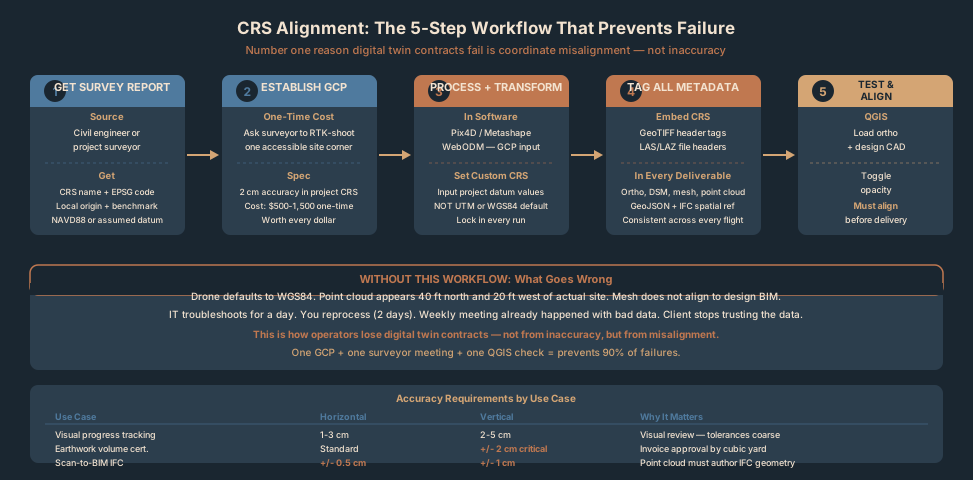
The Coordinate Reference System Problem—And How to Fix It
Digital twin data fails more often due to coordinate system misalignment than due to actual measurement inaccuracy.
What happens:
Contractor uses local grid for the project. Civil engineer set local origin, bearing north, all design docs use this CRS. You fly, process data in WGS84 (drone’s default GNSS), upload to the platform. Point cloud appears 40 feet north and 20 feet west of reality. Mesh doesn’t align. Deviation flagging breaks.
IT troubleshoots for a day. They call you. You say “I’ll reprocess with correct CRS.” Two days later, you reprocess (they’ve already started analyzing), upload again. Weekly meeting already happened with bad data.
Workflow problem, not technical. But number one reason contractors stop paying for digital twin data. Not inaccuracy. Misalignment.
How to prevent it:
-
Get the survey report. Ask project surveyor or civil engineer for survey notes. CRS is defined there. Example: “Local grid based on State Plane, NAD 83 (2011), Ohio North, local origin Monument A (2,546,320 E, 473,640 N State Plane, 1,246 ft NAVD88).”
-
Establish one control point. Ask surveyor to shoot one GCP with RTK—a site corner, anywhere accessible. Coordinates in project CRS. Cost: $500–1,500, one-time.
-
Include that GCP in your first flight. Use it in photogrammetry processing. Pix4D, Metashape, WebODM all accept GCP coords. Set reference to “Custom CRS” and input project datum values.
-
Lock CRS in all processing. Export orthomosaics, DEMs, point clouds with CRS in metadata. GeoTIFF headers, LAS files both support CRS tags.
-
Test alignment before delivery. Load first orthomosaic + design CAD in QGIS. Toggle opacity. Should align. If offset, catch it before client does.
One control point. One surveyor meeting. One QGIS check. Prevents 90% of failures.
Who Buys Digital Twin Services
Digital twin construction contracts are sold, not found. You need to know who the buyer is and where they hang out.
Primary buyer: General Contractors (GCs)
GCs manage build schedule and budget. Most exposed to slips and rework. Two-week delay on $100M project = $250K+ overhead. Digital twins prevent that.
- Budget: Large GCs ($500M+ annual) allocate $5k–20k/project. Mid-market ($50–500M) allocate $2k–8k.
- Decision maker: Project Controls Manager or VP Field Ops. Cares about schedule, cost, risk mitigation.
- Procurement: RFQ to 3–4 vendors, often bundled with surveying and aerial work.
Secondary buyer: Building Owners / Developers
Developers and institutional owners (universities, hospitals, corporations) want independent progress and quality verification. Protecting capital investment, want third-party eyes on the build.
- Budget: $1.5k–4k/month, often approved independent of GC budget
- Decision maker: Project Manager or Owner’s Representative. Cares about QA and timeline verification.
- Procurement: Often direct negotiation, not RFQ. Hiring you as an advocate.
Tertiary buyer: Facility Managers
At closeout, FM needs as-built baseline. Digital twins feed directly into CMMS and FM platform. Built during construction eliminates expensive as-built surveying and 3D modeling at project end.
- Budget: $3k–6k for turnover deliverables (final IFC, point cloud archive, complete building orthomosaic)
- Decision maker: Director of Operations or Facilities Manager
- Procurement: Part of closeout punch list. Usually paid from retention or closeout budget.
How to find them:
-
LinkedIn. Search “Project Controls Manager,” “Construction Controls Manager,” “Owner’s Rep” at GCs and developers in your region. Connect with 50–100. Share 1–2 posts/week on digital twins and construction data. Q2–Q3 (bid season), pitch directly.
-
Industry associations. AGC, CFMA, CECA. Sponsor breakfast, coffee, happy hour. Attend monthly meetings.
-
Existing surveyors and PE firms. They work every project. Get introductions to their GC clients. “I’m adding digital twin services—can I present?”
-
Construction software conferences. Touchplan, Procore, Bridgit Bench summits. Attracts PMs and controls pros actively evaluating tech.
-
Bid boards and project announcements. When a $50M+ project breaks ground, GCs get announced. Find them. Cold call the project PM.
The Recurring Revenue Math
One-off flights:
- Fee: $500–2k/flight
- Solo operator annual: 100–150 flights
- Revenue: $50k–300k (feast/famine, inconsistent)
- Recurring: Zero
Digital twin Tier 1:
- Monthly fee: $3k
- Duration: 12–18 months
- Total value: $36k–54k
- Effort: 3–4 hours/week = 180 hours/year
- Revenue per hour: ~$200
- Recurring: Yes
Digital twin Tier 2:
- Monthly fee: $6k
- Duration: 12–18 months
- Total value: $72k–108k
- Effort: 6–8 hours/week = 350 hours/year
- Revenue per hour: ~$200–280
- Recurring: Yes, higher rate
Why one client beats 50 one-off jobs:
$36K digital twin = 50 flights at $700/flight, but paid monthly over 12 months. Predictable cash flow. Own the relationship—no bidding every month. Understand the project—accuracy improves as you learn CRS, topography, client needs. Client is vested in your success.
One digital twin client sustains you for a year. Three concurrent clients sustain full-time at 20 hours/week—leaving 20 hours for one-off work, training, or biz dev.
Getting Started: Minimum Viable Setup
Build incrementally. Don’t need everything to start.
Month 1: Foundations
- RTK drone: DJI Mini 4 Pro w/ RTK ($3.5k) or Mavic 3T Standard.
- Learn CRS workflow. QGIS Coordinate Transformation plugin. Process one practice dataset with CRS transformation.
- WebODM account (free) or Pix4D education license ($99/year). Learn ortho + DSM export.
- Deliver one Tier 1 POC to friendly client (small project, someone you know). Charge $1k. Focus on CRS alignment and consistent weekly delivery.
Month 2: Tier 1 Launch
- Price Tier 1 at $2.5k–3.5k/month for initial contracts.
- Target local contractors with 2–3 concurrent projects.
- Pitch: “Weekly progress docs, cloud delivery, 24-hour processing, CRS-aligned to project datum.”
- Land one 6-month contract. $15k revenue.
Month 3–4: Tier 1 Refinement + Tier 2 Build
- Automate Tier 1 workflow. WebODM batch overnight—feed images, wake to orthos.
- Learn 3D mesh export. Pix4D and Metashape both do glTF. Know file sizes, performance, storage.
- Integrate DroneDeploy or iTwin. Get familiar with UI, API docs, data upload.
- Build first Tier 2 POC: ortho + DSM + mesh in DroneDeploy, 2–3 manual variance reports. Charge $4k/month to second client.
Month 5–6: Tier 2 Growth
- Land one Tier 2 contract. $24k–48k over 6–12 months.
- Now you have 2–3 projects in recurring revenue. Hire part-time GIS analyst or VA for data delivery and reports.
- ~$40k–60k annual recurring revenue from 2–3 clients. Plus one-off work. Sustainable.
Year 2: Tier 3 Exploration
- Tier 1 and 2 running predictably? Explore Tier 3.
- Requires LiDAR ($8k+) and BIM knowledge. Don’t buy until Tier 3 contract is lined up.
- Partnership model: Find local surveying firm or BIM consultant. You do drone work + CRS. They do scan-to-BIM IFC. Split 60/40 (you 60% for flight/capture, they 40% for BIM).
FAQ
Q: Can I do digital twin work with a consumer drone (no RTK)?
A: Tier 1 only. Without RTK, you need GCPs for CRS alignment. Adds $500–1.5k survey cost per flight. Tier 1 pricing doesn’t absorb GCP costs. Serious about digital twins? Get RTK.
Q: What if the client has no defined CRS? Just GPS coordinates?
A: Recipe for failure. Push back. Ask surveyor to establish local grid. If they won’t, the project is immature and will likely change CRS mid-build (kills your digital twin). Wait for a project with professional survey control.
Q: Do I need to be a PLS (Professional Land Surveyor) to do digital twin work?
A: Not for visual progress documentation and point clouds. But if your deliverables are used for contractual payments—earthwork volumes certified for invoice approval—or if they inform engineering design decisions, you may need PLS responsible charge depending on your state. See Where the Legal Lines Are.
Q: Point cloud vs. mesh? Which to deliver?
A: Point cloud = millions of 3D coordinates. Mesh = surface built from points. Point clouds denser, better for measurement and clash detection. Meshes faster to view and render, better for visual context. For digital twins, deliver both—platforms use them differently.
Q: Processing time for weekly flight?
A: 300–500 images, typical runtime 2–8 hours depending on quality, overlap, compute. $20/month WebODM cloud processes overnight. Local processing = 8 hours normal. Why Tier 1 works: the work happens while you sleep.
Q: Can I use 3D Gaussian Splats instead of meshes?
A: Eventually. 3DGS is emerging (DJI Terra 5.0 added export late 2025). Most platforms don’t accept it natively yet—they want glTF, OBJ, or proprietary formats. In 2026, 3DGS is a differentiator. By 2028, standard. Start experimenting now.
Q: How do I handle weather delays?
A: Build it into the contract. Standard language: “Weekly flights on [agreed day], weather permitting. If weather blocks scheduled flight, next flight within 72 hours. Three consecutive cancellations = prorated fee.” Clients accept this.
Q: What if contractor wants more than weekly flights?
A: Charge more. Standard = 1x/week. 2x/week = 1.5x monthly fee. Daily = 2.5x. Discourages frivolous demands while allowing flexibility for critical phases.
Q: How do I stay competitive against cheaper operators?
A: Don’t compete on price. Compete on accuracy, reliability, maturity. A contractor won’t switch vendors mid-project even for 20% savings—context switching costs too much. Win the first contract with excellent execution. Renewals and referrals follow.
Digital twins are moving from novelty to mainstream. Contractors ask for them. Owners want them. Facility managers need them. The barrier is workflow, not technology.
Master three things:
-
CRS alignment. Get the project’s local coordinate system right from day one. 90% of what breaks contracts.
-
Recurring revenue. Stop pitching per-flight. Start pitching monthly engagement. One $5K/month client beats ten $500 one-off flights.
-
Tier strategy. Start Tier 1 (ortho + DSM). Land two contracts. Build Tier 2 (add mesh + BIM overlay). Land one contract. Then explore Tier 3 (LiDAR, IFC, integration) as partnership.
One successful digital twin contract teaches more than 50 blog posts. Start small, execute flawlessly, let contracts compound. That’s how you break into construction.
Related Reading
- Coordinate Systems for Drone Operators: The #1 Mistake That Breaks Your Deliverables
- Drone Mapping vs. Land Surveying: Where the Legal Lines Are
- 3D Gaussian Splatting for Drone Operators: When to Use It (And When to Stick with Photogrammetry)
- Drone Survey Positioning: GPS vs RTK/PPK vs GCPs—Which Tier Do You Actually Need?
Tools & Resources
- GSD Calculator — Calculate flight altitude for your desired GSD
- GCP Calculator — Determine GCP count and placement for your accuracy requirement
- Bentley iTwin Platform
- Autodesk Tandem
- DroneDeploy
- WebODM