
On the morning of April 29, 2026, the crew of United Airlines Flight 1980 — a Boeing 737-800 carrying 48 passengers and 6 crew on final approach to San Diego International Airport — radioed air traffic control with a report nobody wanted to hear: they had struck a drone.
The object was described as small, red, and shiny. It was moving slowly relative to the 737. The altitude was approximately 3,000 feet.
Three thousand feet. In Class B airspace. On a commercial airport approach path.
The aircraft landed safely. United’s maintenance team found no damage. The FAA and FBI San Diego are both investigating. And for anyone who holds a Part 107 certificate and operates near a controlled airport, the incident deserves more than a headline.
The Altitude Problem
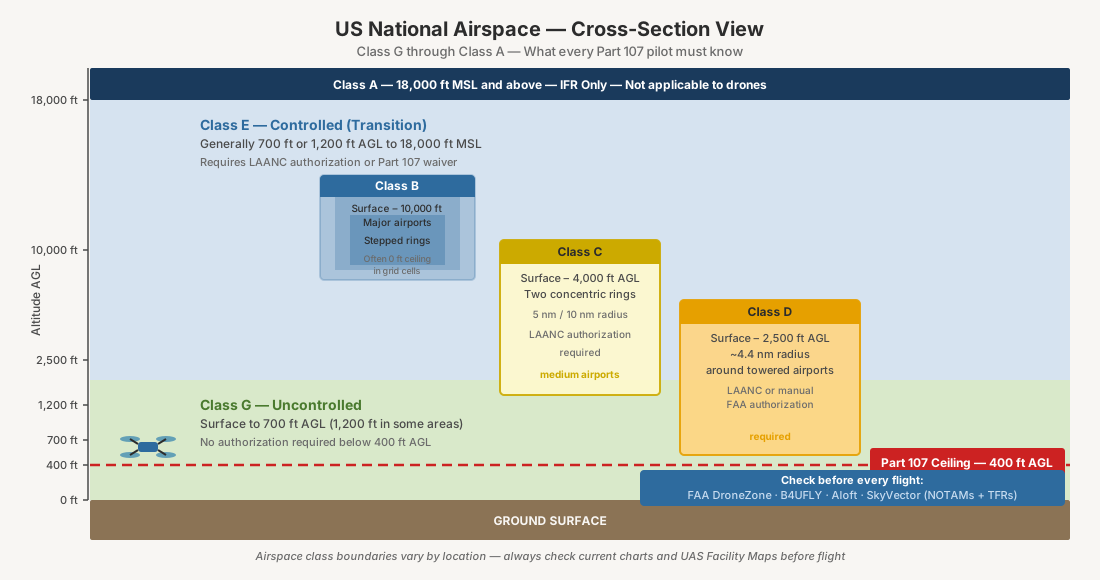
FAA regulations under Part 107 limit drone operations to a maximum of 400 feet above ground level without explicit FAA authorization. That number isn’t arbitrary — it reflects the typical lower floor of controlled airspace, the threshold below which most manned traffic doesn’t operate under normal conditions.
Three thousand feet is 7.5 times that ceiling.
Flying a drone at 3,000 feet on approach to a major commercial airport isn’t a gray area. It’s not a technicality or a misunderstanding of the rules. It’s a deliberate act — whether the operator understood the consequences or not — in the most restricted civilian airspace class in the United States.
San Diego International Airport is surrounded by Class B airspace. Class B is the controlled airspace environment built specifically around the country’s busiest commercial airports. Think of it as an inverted wedding cake, with successive layers that extend outward and upward from the airport surface. Within the innermost ring at SAN, Class B airspace begins at the surface. The outer rings have floor altitudes that step up with distance — but at 3,000 feet on final approach, you are well inside the core.
To operate a drone in Class B airspace, you need a LAANC authorization or an explicit FAA waiver. No authorization exists for 3,000 feet on a commercial airport approach path. None would be granted.
What Mixed Airspace Actually Looks Like
The aviation industry uses the phrase “mixed airspace” to describe the operating environment where manned and unmanned aircraft share altitude bands — typically the 200–400 foot range where delivery drones, recreational flyers, and low-level manned traffic occasionally intersect. There are decades of research, proposed detect-and-avoid standards, and pending regulatory frameworks built around making that altitude range work safely.
What happened near San Diego International Airport is not mixed airspace in that sense. This is manned airspace — a commercial arrival corridor — with an unauthorized drone operating at airliner altitude.
A Boeing 737-800 on a stabilized approach is descending at roughly 700–800 feet per minute, covering ground at approximately 140 knots (160 mph). The crew has seconds between visual acquisition of an obstacle and the point of possible impact. At 3,000 feet on final, the crew is heads-down on instruments, monitoring approach briefings, configuring flaps and gear, and confirming callouts with ATC. The closure rate between the aircraft and a slow-moving object makes visual avoidance difficult under the best conditions.
The 737 crew reported the object as “slow-moving.” That description — relative to a 140-knot aircraft — means essentially stationary. A hovering drone on an approach path is an unlit, uncooperative, non-transponder-equipped obstacle. It doesn’t show on TCAS. It doesn’t talk to ATC. It gives no indication of its position to any other aircraft in the area.
The FAA reported that no other nearby pilots confirmed a drone sighting, and ATC alerting produced no additional reports. Which raises the question: was there one drone, or were there none? The investigation is ongoing. United’s maintenance crews found no physical damage on the aircraft. The airline itself stated there is “no indication that the aircraft struck the drone or vice versa.”
What remains certain is that the crew believed they hit something at 3,000 feet, described it as a drone, and that report triggered a federal investigation. Whether contact was confirmed or not, something was in that airspace.
The Physical Consequences
Drone operators who haven’t thought through the physics of an airborne collision tend to assume size matters in their favor. A small drone versus a large airliner — surely the aircraft wins.
The aviation industry stopped thinking in those terms after the first serious drone ingestion studies. A 2-pound quadcopter is a solid object moving at zero knots relative to a 160-mph aircraft. That kinetic energy is substantial — and it’s delivered by a rigid object with lithium-polymer batteries, hard motor mounts, and a plastic airframe that does not compress or dissipate energy the way a bird does. A bird, given the same mass and speed, compresses. A drone does not.
University of Dayton Research Institute drone impact testing (2018) confirmed what engineers expected: even a small commercial drone can penetrate a jet engine’s fan blade assembly in ways that cause structural failure. The windshield of a commercial aircraft, certified to withstand 4-pound bird strikes at typical operating speeds, was not designed for a rigid quadcopter.
United’s 737 landed without damage. That is the outcome everyone needed. It is not the outcome guaranteed by physics if the contact had been with an engine inlet or the windshield at a slightly different angle.
Criminal and Civil Exposure
The FAA is investigating. The FBI San Diego Field Office confirmed it is working with law enforcement partners to evaluate the situation, noting reports of an alleged drone approximately 12 miles from San Diego International Airport.
Federal criminal liability for unauthorized drone operations near airports falls under 49 U.S.C. § 46307, which provides for fines and imprisonment up to one year — before any charges related to reckless endangerment of an aircraft, which carry substantially more exposure.
On the civil side, an FAA civil penalty for commercial operators can reach $27,500 per violation. If the drone was operated by a Part 107 holder — which would mean they flew without authorization in Class B airspace, exceeded maximum altitude by 650%, and operated in an airport arrival corridor — you’re looking at multiple overlapping violations.
If you operate commercially and your drone is involved in an incident like this, your Part 107 certificate is likely gone, your equipment is evidence, your identity is traceable through Remote ID, and federal prosecutors have a clear statutory path to criminal charges.
What Responsible Part 107 Operators Do
None of this is directed at operators doing the work correctly. If you’re reading AeroCartwright, you probably already know how to pull up a sectional chart, request LAANC authorization, and understand what a Class B Mode C veil means.
But incidents like San Diego are useful pressure tests for your own pre-flight habits. Walk through it:
Before any flight within 30 miles of a commercial airport:
- Open a sectional chart and identify the airspace class at your planned altitude — not just at ground level.
- Request LAANC authorization before wheels-up through an approved provider (Aloft, Kittyhawk, SkyGrid, or AirMap). LAANC approval is not a formality; it’s your legal authorization to enter controlled airspace.
- Understand that LAANC provides clearance at specific altitudes. An approval for 200 feet does not authorize you to climb to 400 feet, and nothing authorizes you anywhere near 3,000 feet.
- Know the Class B floor altitudes for your position. SAN’s Class B structure has floors at 1,200 feet, 2,000 feet, and higher depending on distance from the airport. At 3 miles from the threshold, you are likely under the surface-level inner ring.
If you haven’t read You Are a Professional Pilot. Act Like One., it’s worth your time. The core point: when the FAA issued your Part 107 certificate, they added you to the same airman database as airline captains. That’s not a metaphor about attitude. It’s a statement about legal standing and regulatory expectation.
The drone that allegedly struck United 1980 may have been operated by someone who never thought of themselves as a pilot at all. That is exactly the problem.
What Comes Next
The FAA investigation will determine whether contact actually occurred. Remote ID data — if the drone was registered and broadcasting — could identify the operator. If not, physical evidence from the aircraft or ground-level camera footage in the approach corridor may help. The FBI involvement suggests federal authorities are treating this as a potential criminal matter regardless of whether damage was confirmed.
For the broader industry, this incident lands at an awkward moment. The FAA is finalizing Part 108 BVLOS rules that would open commercial corridor operations above 400 feet for authorized operators. The regulatory argument for expanded drone access depends on an operating culture of discipline and compliance. Every unauthorized flight at 3,000 feet over a commercial airport makes that regulatory argument harder to sustain.
The people who fly responsibly — who check the sectional, request LAANC, stay within authorization — are the ones who ultimately carry the reputational cost of incidents like this one.
The FAA investigation into United Flight 1980 is ongoing. Details may change as findings are released.