
You’re standing at a survey site. The project needs sub-centimeter accuracy. Your drone supports both RTK and PPK. The equipment manager asks: which do you want?
The textbook answer is they’re equally accurate, so it shouldn’t matter. Except it does — but not for the reason most people think.
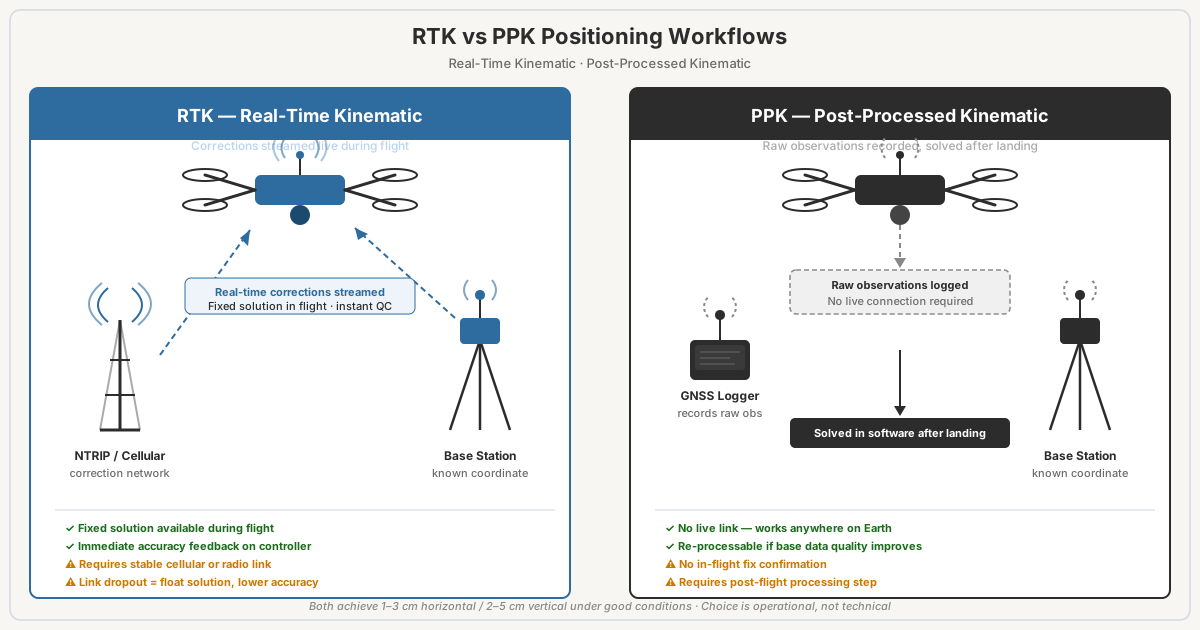
Here’s the thing about RTK and PPK: they solve the same problem using different timing. Both deliver 1–3 centimeters horizontal and 2–5 centimeters vertical. The difference is when they fail — and what you do when they do. Choose the one that breaks in ways you can handle.
RTK: Real-Time Positioning, Real-Time Liability
RTK stands for Real-Time Kinematic. Here’s how it works in the field.
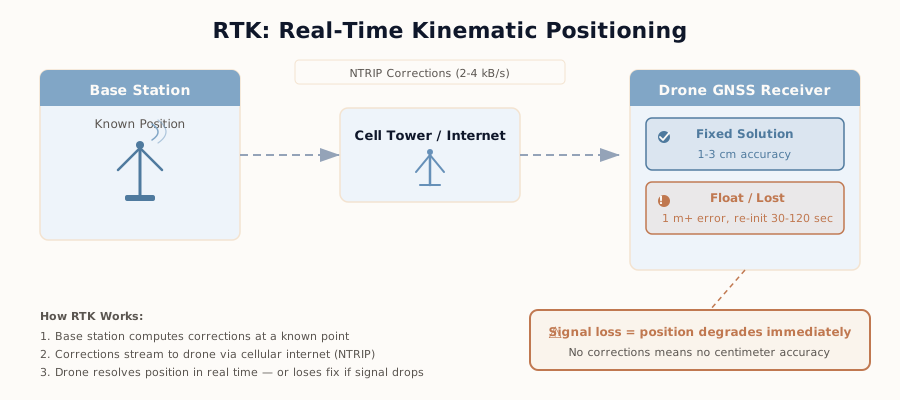
You set up a ground base station at a known location. It measures raw GNSS signals and computes where it should be versus where the satellites say it is — that’s your position error. Then it streams those corrections to the drone receiver in real time, typically 2–4 kilobytes per second via cellular, radio, or an NTRIP network connection.
The drone receiver takes that correction stream, applies it to its own satellite measurements, and resolves the integer ambiguities in the carrier-phase data. Lock onto a “fixed” solution and you get sub-centimeter accuracy. Lose the correction stream and you drop to “float” — meter-level noise that looks like good data but isn’t.
The critical problem: initialization. Most RTK receivers need 30 seconds to 2 minutes of continuous correction signal to lock a fixed solution. Lose signal mid-flight and you’re back to the beginning — another 30 to 120 seconds of re-initialization while the drone geotags your photos with garbage coordinates. You won’t know until later.
On DJI platforms, the solution type gets embedded in your EXIF data: 50 means fixed (good), 34 means float (useless), 16 means single (useless). I’ve seen projects where only 70 percent of images came back fixed — 8 centimeters of vertical error in urban areas, and that’s if you catch it during processing. Open field with 99 percent fixed? 2.7 centimeters. That’s the spread.
This is why auditing solution types after every flight is non-negotiable. Not optional. Non-negotiable.
Multi-constellation receivers — GPS, GLONASS, Galileo, BeiDou all at once — initialize faster and hold lock more stably than GPS-only. That’s standard now. More satellites in view means better geometry and faster ambiguity resolution, with the largest gains in constrained environments where single-constellation coverage has gaps. But ideal conditions still matter: poor satellite geometry in a mountain valley, multipath bounce from buildings, weak cellular signal — all of it introduces error and costs you lock.
What breaks RTK? The real-time correction link. Cellular dies mid-flight. NTRIP server goes down — rare, but it happens. Your antenna sits in the shadow of a building and multipath takes over. The drone loses corrections, solution drops to float, and you’re busy flying instead of watching your RTK status monitor. Be honest — you’re probably not watching it.
Most RTK drones have holdover mode: the receiver coasts for a few seconds on inertial measurements, then gives up and tags the rest of your photos as degraded quality — or just stops tagging altogether depending on the platform.
Here’s the uncomfortable truth: you discover the real-time correction link failed after you’re back in the office — not before you leave the site.
PPK: Post-Processing, Post-Flight Verification
PPK stands for Post-Processed Kinematic. Different operational concept entirely.
You set up a base station before the flight — same as RTK — but it just logs raw observations. The drone logs raw observations too. Both record satellite data, not processed positions. After you land, you download those raw files and run them through post-processing software: Emlid Studio, RTKLIB, Leica Infinity, Metashape — whatever your shop uses.
The software treats the drone and base as a tight constraint: they see the same satellites, so their measurements are correlated. That correlation is powerful. Solving the entire trajectory jointly — drone and base together — resolves ambiguities that the drone data alone can’t touch. That’s why PPK achieves the same 1–3 centimeter horizontal and 2–5 centimeter vertical accuracy as RTK.
No real-time link required. No cellular dependency. No initialization delay during flight. You just fly.
The tradeoff is time and discipline. You spend 30 to 60 minutes on the ground getting the base deployed and positioned — especially on new locations where the base hasn’t autonomously refined its position yet. You synchronize the drone and base station clocks before flying. I cannot overstate this. A one-microsecond clock error produces roughly 300 meters of position error. Light travels 300 meters per microsecond — the math is unforgiving. I’ve seen it happen. And before you leave the site, you connect the drone to a computer, pull the raw observation files, and verify they logged correctly. No exceptions.
That last step? Most operators skip it. Then they discover four hours later at the office that 30 minutes of their flight is worthless because the base station never initialized, or the SD card corrupted, or they missed a sync.
Recent research comparing RTK and PPK directly — Arkali and Atik in 2025 — found PPK horizontal RMSE of 3.5 centimeters versus RTK at 3.7 centimeters. Essentially identical. Famiglietti et al. validated the Emlid RS2 at 1.94 centimeters vertical accuracy, matching professional equipment at one-third the cost.
PPK performs slightly better in practice because all the data exists — you reprocess if you find a problem. RTK’s advantage is immediate feedback in the field. That’s the tradeoff.
The Failure Modes That Matter
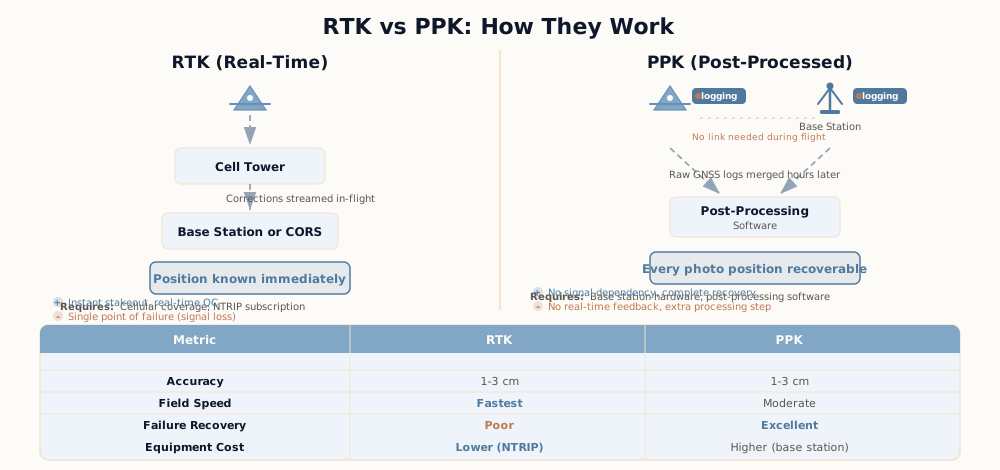
RTK fails like this: You’re flying, signal is good, everything looks fine. Then you drift out of cellular range or NTRIP drops out, and half your images are tagged with float solutions. You don’t know until you’re processing. The good news — you land, wait for re-lock, fly that section again. The bad news — you won’t realize there’s a problem until you’re back in the office.
PPK fails like this: You deploy the base, verify it looks good, fly the mission clean. But the base station clock drifted, or you entered the base location wrong in post-processing, or the raw files didn’t write completely because the SD card ejected early. You discover all of this when you sit down to process — and by then you’ve already left the site. No going back.
Both workflows carry the same garbage-in-garbage-out risk: misplace your RTK base by 10 meters and you’re 10 meters wrong everywhere. You won’t know until you check against surveyed points. Same with PPK — wrong base location in post-processing means wrong answers across the entire flight. RTK gives you wrong answers immediately. PPK gives you wrong answers hours later.
This is why pre-departure file verification is critical in PPK workflows. Not nice-to-have. Critical.
Do You Still Need GCPs?
Yes.
I know that’s not what you want to hear. RTK and PPK both correct your antenna position down to sub-centimeter. Neither corrects systematic error from base station misplacement. If your RTK base sits 10 meters from where you think it is, you’re wrong everywhere — sub-centimeter precision around the wrong location.
The only way to confirm your accuracy is ground truth. Surveyed checkpoints measured after the flight, compared against your drone coordinates. That means GCPs or independent checkpoints.
I’ve worked with operators who flew RTK-only and checked themselves against ground truth. Sometimes they were great. Sometimes they discovered systematic errors that only post-flight GCP correction caught. The professional standard is simple: validate with checkpoints. You can reduce GCP counts from 8 down to 5 if you’re flying RTK well — but you’re not eliminating them.
Same goes for PPK. Post-processing doesn’t validate your accuracy — it refines it. You still need independent checkpoints to know you’re good.
For the broader “which positioning tier do I actually need” decision — before the RTK vs PPK choice even comes up — see the four-tier positioning framework.
Cost Reality Check
RTK hardware is expensive upfront. An RTK-capable drone runs $2,000 to $20,000 depending on platform. Then you need a way to send corrections: NTRIP subscription at $40 to $150 per month, or your own base station ($1,500 to $5,000).
PPK upfront: a non-RTK drone ($1,500 to $15,000) plus a base station that logs raw observations. An Emlid Reach RS3 runs about $2,999. Post-processing software ranges from free (RTKLIB, Emlid Studio) to $3,499 perpetual (Metashape Professional) to $399 per month (Pix4Dmapper).
Field setup time: RTK takes about 10 minutes. PPK takes 30 to 60 minutes, especially on a new location.
Post-processing: RTK skips this step if you geotagged correctly in flight. PPK needs 30 minutes to 2 hours depending on mission duration and software.
Here’s the calculus: fly the same site repeatedly and the RTK subscription cost spreads across many projects. Flying 10 or 20 days a year on mostly one-off projects? PPK’s base station is cheaper and removes the cellular dependency entirely. The math is simple.
When to Choose RTK
RTK is your method if cellular coverage is solid at the site and you need real-time geotagging. You want immediate feedback — live orthomosaic on the tablet, in-field validation before you leave — RTK delivers that. Repeated surveys at the same location? The monthly subscription amortizes fast. Turnaround is critical and you want minimal post-processing? RTK is simpler.
Urban construction sites? RTK wins. Cellular is everywhere, you’re flying the same site multiple times a month, and the client wants updates fast.
When to Choose PPK
Pick PPK if cellular is poor, expensive, or unavailable—remote wilderness, international sites, places where infrastructure doesn’t reach. If you want reproducible accuracy validation (raw data sits there, post-processing is deterministic and repeatable), PPK gives that to you. If you prefer operational simplicity—no real-time link to manage mid-flight, no initialization delays, just log and go—PPK is cleaner.
Remote archaeological sites? One-off environmental surveys? Anywhere cellular is either spotty or costs too much to justify? PPK wins. And if you already own survey-grade equipment that logs raw observations, the decision’s made.
What Actually Matters
The choice comes down to logistics and risk tolerance. Both methods achieve identical accuracy under good conditions. Both require checkpoint validation — that’s how you know you’re actually good. Both fail. Just in different ways, at different times.
RTK fails in the field, visibly, and you can fix it by re-flying. PPK fails silently during flight and gets discovered in post-processing, but you can catch it before leaving site if you verify files.
RTK requires a real-time correction link that can disappear. PPK requires discipline on-site setup and pre-departure verification that most people skip.
Both are in active use across the industry. PPK tends to win on remote work where cellular infrastructure is unreliable. RTK tends to win on urban construction contracts where the client wants real-time visibility. Neither is universally better — they fit different operational scenarios.
Good cellular, repeated flights at the same site — RTK wins. Remote site, one-off project, time for base station setup — PPK wins. Neither condition clearly applies? They’ll produce nearly identical checkpoint accuracy because you’ll validate both with independent survey points anyway.
That’s the real difference: not accuracy, but how fast you get confidence in it.
For more on accuracy standards and validation, check out ground control points.