

You win a stormwater mapping bid for a county. The contract says “NDAA-compliant aircraft.” Your fleet is two DJI airframes. Does that clause actually bind you, and if it does, does it mean “not Chinese,” “on the Blue UAS list,” or something else?
Those are three different requirements, and the answer depends on whose money is paying for the job. This guide separates the four terms that get used interchangeably — NDAA-compliant, Blue UAS, Green UAS, and “not on the FCC Covered List” — cites the statute or rule behind each, lays out who actually needs a compliant aircraft, and lists the mapping-capable platforms on the government’s list as of October 1, 2026, with the prices manufacturers publish.
Four Terms That Are Not Synonyms
| Term | Who decides | What it actually means | Source |
|---|---|---|---|
| NDAA-compliant | Usually the manufacturer | No single legal definition. Shorthand for an aircraft that avoids what Section 848 prohibits for the Defense Department: manufacture in a covered country, and covered-country flight controllers, radios, data transmission devices, cameras, gimbals, ground control software, or data storage | FY2020 NDAA, Sec. 848 |
| Blue UAS | Department of War (DCMA since December 3, 2025) | A specific list of aircraft and components that were assessed and cleared for Defense Department purchase | DCMA Blue List |
| Green UAS | AUVSI, a trade association | A private certification covering corporate cyber hygiene, product and device security, remote operations and connectivity, and supply chain risk management | AUVSI Green UAS Cleared List |
| Not on the FCC Covered List | FCC | The equipment can still receive new FCC equipment authorizations. A radio-licensing status, not a procurement approval | FCC DA 26-957, Appendix A |
To put it plainly: “NDAA-compliant” is a claim, Blue UAS is a list, Green UAS is a private certificate, and the Covered List is about whether a radio can be authorized for sale. A contract that names one does not automatically accept the others.
What the Federal Statutes Actually Say
Section 848: the Defense Department rule
Section 848 of the FY2020 NDAA (Pub. L. 116-92) says “The Secretary of Defense may not operate or enter into or renew a contract for the procurement of” an unmanned aircraft system that is “manufactured in a covered foreign country or by an entity domiciled in a covered foreign country,” or that uses “flight controllers, radios, data transmission devices, cameras, or gimbals” made there, ground control or operating software developed there, or network connectivity or data storage located there. As enacted, the only covered country was China.
Section 848 is a Defense Department provision. It did not, by itself, reach civilian agencies.
Section 817: Russia, Iran, North Korea, and contractors
Section 817 of the FY2023 NDAA amended Section 848 in two ways that matter to a mapping firm. It expanded “covered foreign country” to China, Russia, Iran, and North Korea. And it added a contractor rule: the Secretary “may not enter into a contract (or extend or renew a contract) on or after October 1, 2024, with an entity that operates … equipment from a covered unmanned aircraft system company in the performance of a Department of Defense contract.” The statute names “Da-Jiang Innovations (or any subsidiary or affiliate of Da-Jiang Innovations)” first in its definition of a covered company.
The Defense Department implemented this through Class Deviation 2024-O0014, which supplies clause 252.225-7972 and solicitation provision 252.225-7973. The department’s open-cases report dated September 25, 2026 shows the underlying DFARS case as closed and folded into Class Deviation 2026-O0025, Revision 3, effective September 3, 2026, whose attached DFARS Part 240 text carries the clause as 252.240-7994 and the representation as 252.240-7993. Read the one in your contract.
The American Security Drone Act: every federal agency, and federal money
The American Security Drone Act of 2023 is Sections 1821 through 1833 of the FY2024 NDAA (Pub. L. 118-31). It extends the restriction government-wide in three steps:
- Procurement (Sec. 1823). An executive agency “may not procure any covered unmanned aircraft system that is manufactured or assembled by a covered foreign entity.”
- Operation (Sec. 1824). Beginning two years after enactment, “no Federal department or agency may operate” one, and the prohibition “applies to any covered unmanned aircraft systems that are being used by any executive agency through the method of contracting for the services of covered unmanned aircraft systems.” That is the drone-services clause. It covers you.
- Federal funds (Sec. 1825). Beginning on the same date, “no Federal funds awarded through a contract, grant, or cooperative agreement, or otherwise made available may be used” to procure such a drone or “in connection with the operation of such a drone.”
The two-year date is December 22, 2025. The implementing regulation, FAR subpart 40.2, uses that date for the operation and federal-funds prohibitions, and states that the authorities “expire on December 22, 2028” under the Act’s five-year sunset (Sec. 1833).
The Act has carve-outs. Section 1830 says nothing in it prevents a state or local law enforcement or emergency service agency from operating a covered drone “purchased with non-Federal dollars,” and Section 1832 exempts wildfire management and search and rescue operations. Neither helps a routine mapping contractor: Section 1832 exempts “the appropriate Federal agencies,” not their contractors, and FAR 52.240-1(d) lifts the prohibition only where the agency has determined an exemption applies “and the contract indicates that such a determination has been made.” Section 1832 also exempts Tribal law enforcement and emergency service agencies for operations on Indian lands.
Who is a “covered foreign entity”
Not every Chinese company, at least not yet. The Act defines a covered foreign entity as one on a list maintained by the Federal Acquisition Security Council and published in SAM.gov. The SAM.gov notice says the list “includes all entities on the Consolidated Screening List” and “does not include any other entities at this time.” As viewed on October 1, 2026, that notice was last updated November 13, 2024.
The Consolidated Screening List download on October 1, 2026 includes DJI (Commerce Entity List since December 18, 2020, and the Treasury Chinese Military-Industrial Complex list) and Autel Robotics (Entity List since June 12, 2024, under the name Shenzhen Daotong Intelligent Aviation Technology Co., Ltd.). Both are covered.
The Defense Department test is broader. It reaches any aircraft made in a covered country or using covered-country critical components, listed company or not.
The clause in your contract
FAR 52.240-1 (Nov 2024) is the government-wide contract clause. It applies to Defense Department contracts too, alongside the DoD-specific clause. Solicitations issued under the FAR Overhaul deviations carry the same prohibition as paragraph (c) of clause 52.240-91, Security Prohibitions and Exclusions; the codified 52.240-1 is marked reserved in that text. The wording is substantively the same, though the paragraph letters differ (the flow-down there is paragraph (j)); the quotations below are from the codified 52.240-1. It prohibits the contractor from delivering a prohibited drone, from “operating a FASC-prohibited unmanned aircraft system in the performance of the contract” on or after December 22, 2025, and from using federal funds for one. It requires the contractor to search SAM.gov for the list “prior to proposing, or using in performance of the contract, any unmanned aircraft system.” And it flows down: “The Contractor shall insert the substance of this clause, including this paragraph (e), in all subcontracts and other contractual instruments, including subcontracts for the acquisition of commercial products or commercial services.”
FAR 40.202-2, as codified, applies the prohibition “to all acquisitions, including contracts at or below the micro-purchase threshold.” There is no small-job exception. The interim rule that created the clause was published at 89 FR 89464 on November 12, 2024.
Federal grants
OMB Memorandum M-26-02 (November 21, 2025) carries Section 1825 into grant terms. Its Appendix D states that on or after December 22, 2025, “no Federal funds awarded through a grant or cooperative agreement, or otherwise made available, may be used by a recipient or subrecipient” to procure a prohibited drone or “in connection with the operation of” one.
This is the provision that reaches a county job. If a federal grant is paying for the survey, the county is a recipient and its use of the money is restricted. How each agency writes that into its award terms varies, and specific grant programs were not reviewed for this article. Ask the client for the award terms.
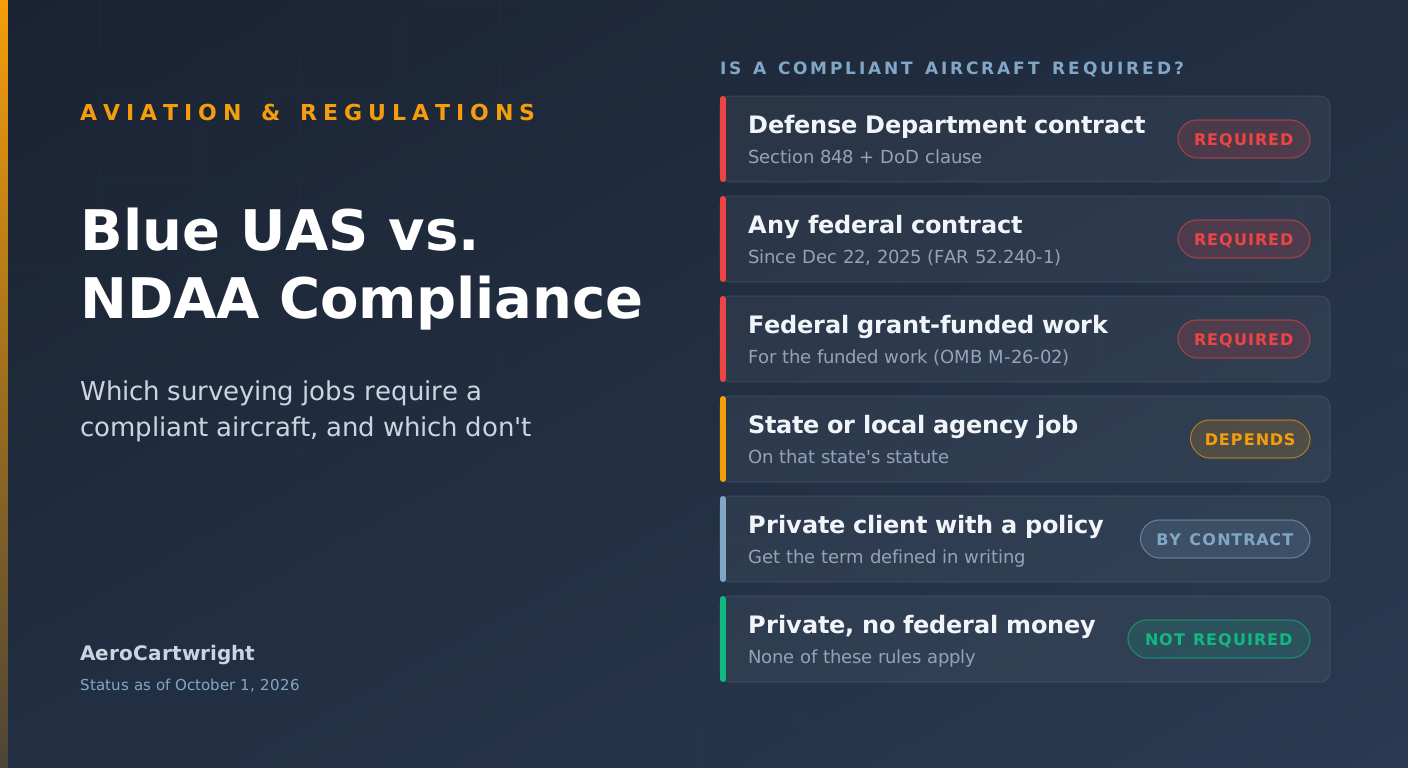
Who Actually Needs a Compliant Aircraft
| Your work | Is a compliant aircraft required? | What “compliant” means there |
|---|---|---|
| Defense Department contract or subcontract | Yes | Not made in China, Russia, Iran, or North Korea, no covered-country critical components, and the contractor must not be an entity that operates covered-company equipment (the clause does not limit this to the contract). Buyers may ask for Blue UAS |
| Any federal contract or subcontract (DoD included) | Yes, since December 22, 2025 | Not manufactured or assembled by an entity on the Consolidated Screening List (FAR 52.240-1) |
| State, local, tribal, or private work paid with a federal grant | Yes, for the federally funded work | Same covered-entity test, applied to recipients and subrecipients (OMB M-26-02, Appendix D) |
| State or local agency work in a state with its own statute | Depends on the statute; some restrict only agency purchases, some reach contracted services | Each state defines it differently; see the next section |
| Private client with a written policy | Yes, by contract | Whatever the contract says. Get the term defined in writing |
| Private client with no policy and no federal money | No | Nothing in these rules applies |
None of the federal provisions above requires Blue UAS by name. A contracting officer or client can require it anyway, and some use “Blue UAS” as a shortcut because the list is easy to check. If a solicitation says “NDAA-compliant,” ask whether the buyer will accept a manufacturer’s compliance statement or wants a Blue-listed aircraft. Get the answer in writing before you mobilize.
The Defense Department describes the Blue list as its “trusted catalog of secure, NDAA-compliant drones and components.” No contract clause says that listing satisfies it, though, and it is not a universal pass: the government-wide FAR clause turns on whether the manufacturer is on the covered foreign entity list, and a state statute such as Mississippi’s, or a Buy American or TAA clause, can exclude a Blue-listed aircraft.
The Blue UAS List on October 1, 2026
The Blue UAS list started at the Defense Innovation Unit in 2020. On December 3, 2025, DIU announced “the formal transition” of the list to the Defense Contract Management Agency, with management moving to “DCMA’s new Unmanned Systems–Experimental Command, or US-X, at Palmdale, California.” DIU ties the move to the Secretary of War’s July 2025 “Unleashing U.S. Military Drone Dominance” memo and says the goal is to move “from a certification program into a true marketplace.” Assessments now run through “Recognized Assessors, a group of third-party organizations evaluating drone platforms and related components for compliance with NDAA.”
The program has described three parts, and contracts mix them up. The definitions below are from the earlier Blue List portal; the current DCMA table shows a single list with a category for each entry.
- Cleared List. Complete aircraft. The earlier portal described it as “DoD approved drones” that are “compliant with current law and policy, validated as cyber-secure, and are available for DoD purchase and operation.”
- Framework. Not aircraft. The earlier portal defined it as “NDAA compliant UAS components and software” — radios, flight controllers, cameras, gimbals, ground stations. A drone built from Framework parts is not thereby a Cleared List drone.
- Select. Platforms added “in response to partner organization needs and through competitive processes.”
The list is now published at bluelist.dcma.mil. On October 1, 2026 it showed 323 entries. By this article’s count, 79 were categorized as aircraft, from roughly 45 manufacturers; the rest were components and software. DIU’s December 2025 announcement gave “over 39 certified Blue UAS systems and 165 components” as of November 19, 2025. The two numbers were counted differently, but the direction is clear.
No DJI, Autel, or Yuneec product appeared anywhere in the 323 entries.
Where Green UAS fits
Green UAS is AUVSI’s certification, not a government list. On July 16, 2025, AUVSI announced that it had been designated a Recognized Assessor and that platforms completing Green UAS certification “are now designated Blue UAS Cleared.” So Green became a route onto the Blue list. It is still a separate credential: if your contract says Blue UAS, confirm the aircraft on the DCMA list itself rather than relying on a Green badge.
Mapping-Capable Aircraft on the Blue List
Every row below was checked against the DCMA Blue List on October 1, 2026. Specifications and prices are the manufacturer’s own published figures on the same date. Where a manufacturer does not publish a price, the table says so instead of guessing.
| Aircraft (Blue List entry) | Type | Mapping facts from the manufacturer | Published price | Source |
|---|---|---|---|---|
| WingtraRAY | Fixed-wing VTOL | Up to 59 min flight time; 61 MP full-frame MAP61 camera; PPK included; “Cover 550 ha in one flight”; LiDAR option at up to 45 min | Not published | Wingtra |
| WingtraOne Gen II | Fixed-wing VTOL | On the Blue list and the AUVSI Green list; specifications not re-verified for this article | Not published | AUVSI list |
| Skydio X10 | Folding multirotor | 40 min max flight time; 64 MP narrow, 50 MP wide, and 48 MP telephoto cameras depending on sensor package; RTK/PPK attachment; “Designed, assembled, and supported in the U.S.” | Not published | Skydio |
| Freefly Astro Max | Multirotor | 61 MP Sony ILX-LR1 mapping payload with 24 mm lens | $28,995 airframe (NDAA/Blue); $43,725 Mapping Essentials kit (NDAA/Blue) | Freefly store |
| Inspired Flight IF800 | Medium-lift multirotor | 54 min max flight time; 6.6 lb max payload; NDAA photogrammetry kit pairs it with a 65 MP global-shutter Sentera 65R and an RTK/PPK module | $23,000 to $34,500 airframe, by controller and care plan (Herelink from $23,000, GS-ONE from $29,500); $55,250 NDAA photogrammetry kit | Inspired Flight store |
| Inspired Flight IF1200 | Heavy-lift hexacopter | 43 min max flight time; 19.1 lb max payload under Part 107; LiDAR carrier | $32,000 to $44,500 airframe, by controller and care plan (Herelink from $32,000, GS-ONE from $37,500); $115,000 to $131,000 NDAA LiDAR kits | Inspired Flight store |
| eBee TAC | Fixed-wing | Manufacturer lists “3D and thermal mapping compatibility” and “Blue UAS certified” | Not published | EagleNXT |
Three cautions about this table.
The entry is the configuration, not the brand. Freefly sells a standard Astro Max and an “Astro Max (NDAA/Blue).” Inspired Flight sells the IF800 and IF1200 with either a Herelink or a GS-ONE controller. Its store puts “NDAA-Compliant” in the title of the GS-ONE kits only, although it describes the Herelink kits as NDAA-compliant too; the GS-ONE has its own Blue List entry, and no Herelink controller appeared on the list on October 1, 2026. Buying the right airframe with the wrong radio or controller can leave you outside the listing. Ask the seller to confirm in writing which listed configuration you are getting.
Other listed aircraft exist. The Quantum Systems Trinity Pro, Parrot ANAFI USA (GOV and MIL versions), and Skydio X10D are on the list. Their mapping specifications were not verified for this article, so they are not in the table.
The list moves. Confirm any aircraft against the DCMA list on the day you bid.
What the Compliance Premium Actually Costs
Claims that compliant drones cost several times more often compare unlike aircraft. Freefly publishes the cleanest like-for-like number, because it sells the same airframe both ways.
- Astro Max: $22,995. Astro Max (NDAA/Blue): $28,995. Difference: $6,000, or 26 percent.
- Astro Max Mapping Essentials: $37,725. The NDAA/Blue version of the same kit: $43,725. Difference: $6,000, or 16 percent.
The product listings show where the money goes. The standard airframe ships with a “2.4ghz radio (non NDAA approved).” The Blue version ships with a “Doodle Labs RF, NDAA and DIU Blue 2.4 GHz radio” and approved firmware. On this airframe, the listed differences are the radio and the firmware, and they cost $6,000.
That is one manufacturer’s price list, not a market average. Wingtra and Skydio do not publish prices, so any figure you see for them came from a dealer, not the manufacturer. Get your own.
Two cost factors sit outside the sticker price. Tariffs: the Section 232 drone tariffs give companies that were on the Blue UAS Cleared List or Framework on September 2, 2026 a delayed effective date of February 9, 2027, covered in the Section 232 tariff breakdown. And processing: before you buy, confirm with the vendor that raw images and geotags export cleanly into the photogrammetry software you already run, whether that is a commercial package or OpenDroneMap. A compliant airframe that locks your data into one vendor’s cloud is a second cost.
The FCC Covered List Is a Different Regime
The FCC Covered List controls which equipment can receive new FCC equipment authorizations. It is not a procurement rule and it does not make an aircraft “compliant.”
Section 1709 of the FY2025 NDAA (Pub. L. 118-159) gave a national security agency one year to determine whether equipment from “DJI Technologies” and “Autel Robotics” poses an unacceptable risk, and directed that if no determination was made, “the Commission shall add all communications equipment and services listed” to the Covered List.
The list went further than those two companies. Its current entry, dated December 22, 2025 and updated several times since, covers “Uncrewed aircraft systems (UAS) and UAS critical components produced in a foreign country,” with exceptions for equipment “included on the Defense Contract Management Agency’s (DCMA’s) Blue UAS Cleared List, until January 1, 2028,” equipment that qualifies as “domestic end products” under the Buy American standard until the same date, devices granted a Conditional Approval by the Department of War or DHS, and toy drones (DA 26-957, Appendix A). The FCC notes that it uses “Blue UAS Cleared List” to mean both the Cleared List and the Framework list of components and software.
Two consequences for surveyors:
- Blue status now matters commercially, not just for government work. Several Blue-listed makers are headquartered outside the United States. For foreign-produced aircraft, the Blue list exception (or a device-specific Conditional Approval) is what keeps new FCC authorizations available, and the Blue exception currently ends January 1, 2028.
- “Not on the Covered List” does not prove NDAA compliance. The Buy American exception turns on domestic content, while Section 848 turns on specific components. An aircraft could plausibly qualify for one and fail the other. That is a reading of the two tests, not a ruling from any agency. Check each requirement separately.
October 13, 2026: DJI and Autel parts inside other makers’ aircraft. A separate FCC order, FCC 26-50, is effective October 13, 2026 (91 FR 57798). From that date the FCC won’t grant a new equipment authorization to any device that contains “a logic-bearing hardware component produced by an entity identified on the Covered List” (new 47 CFR 2.903(b)(2)). Among drone makers, the most relevant names are DJI and Autel and their affiliates and partners as named in Section 1709, but the rule covers parts from every company named on the list, Huawei and ZTE included. The FCC says it does not reach components from companies that are covered only by the foreign-production entry (para. 37).
The Blue list, Buy American and Conditional Approval exceptions get an aircraft past the foreign-production entry. They don’t help a new model that carries a DJI- or Autel-made wireless chipset, cryptographic element or battery-management board (the FCC’s own examples, paras. 22 and 28). The component ban applies only to new authorizations: equipment already authorized “may continue to be marketed, imported, and used” (para. 38). For a buyer, the practical effect is to check new models and payloads whose FCC applications were filed on or after October 13, not the fleet you already own. The FCC article covers the rule in more detail.
Aircraft you already own are not grounded by any of this. A separate FCC proposal would bar further import and marketing of some previously authorized “military-grade” covered equipment; the comment deadline passed September 2, 2026 and the FCC had issued no decision as of October 1, 2026. The FCC Covered List and DJI LiDAR article tracks that proceeding.
State Laws: Four Statutes, Four Different Tests
State restrictions are written for the agency, and each one draws the line somewhere different. Four enacted statutes show the range.
Florida. Section 934.50(7), Florida Statutes applies to “any state, county, local, or municipal governmental entity.” It requires that “By January 1, 2023, all governmental agencies must discontinue the use of drones not produced by an approved manufacturer.” The implementing rule, Fla. Admin. Code R. 60GG-2.0075, says an agency “may not purchase, acquire, or otherwise use a Drone or any related services or equipment produced by a manufacturer domiciled in, or produced by a manufacturer the Governmental Agency reasonably believes to be owned or controlled (in whole or in part) by, a Foreign Country of Concern.” The rule borrows its definition from section 286.101(1)(b): China, Russia, Iran, North Korea, Cuba, the Venezuelan regime of Nicolás Maduro, and Syria, “including any agency of or any other entity under significant control of” one of them. The phrase “related services” is the part a contractor should ask the agency about.
Mississippi. Senate Bill 2853 (2023), codified at Miss. Code § 31-7-67 and amended in 2024 by House Bill 297, is the strictest of the four. Beginning January 1, 2025, drones purchased by the state “or any agency or political subdivision thereof shall be purchased exclusively from a domestic manufacturer.” It reaches one kind of contractor directly: “All infrastructure inspection services requiring the use of sUAS and contracted for on behalf of the State shall be performed using domestically manufactured sUAS.” That sentence covers infrastructure inspection contracted for the State; the text does not address other contracted mapping. An agency also “may not purchase or operate a small unmanned aircraft system manufactured in the People’s Republic of China,” which includes aircraft assembled elsewhere from “more than a negligible amount” of Chinese parts, software, components, or raw materials. The 2024 amendment exempts Chinese-made aircraft “purchased prior to January 1, 2025” from the section. Domestic means a U.S.-incorporated, U.S.-headquartered, majority American-owned company manufacturing in the United States; if another entity owns it, that entity “must also be an American company.” On that definition, a Blue-listed aircraft from a European maker would not qualify.
Tennessee. Public Chapter 223 (2023) says a state agency, and separately a local agency or law enforcement agency, “shall not purchase or acquire a drone … produced by a manufacturer banned under Section 889 of the National Defense Authorization Act of 2019, as amended.” It is a purchase restriction; the text does not address contractor-operated aircraft. Section 889 names telecommunications and video surveillance companies, not drone makers, so how the reference applies to a given manufacturer is a question for the agency’s counsel.
Arkansas. Act 525 of 2023 bars a public entity from purchasing a small unmanned aircraft system “manufactured or assembled by a covered foreign entity,” defined to include entities on the Consolidated Screening List or Entity List, those domiciled in China or Russia or “under the influence or control” of either government, and their subsidiaries and affiliates. The operating ban starts later: “On or after May 1, 2027, a public entity shall not operate” one. A separate provision bars state funds awarded “through a contract, grant, or cooperative agreement” from being used in connection with operating one unless waived, and that provision carries no delayed date.
Other states have enacted or proposed similar laws. They were not verified for this article, so they are not listed. For any state agency job, ask the procurement officer which statute or policy the drone language comes from, then read it. A university or utility may also have its own procurement policy that is stricter than the statute.
Contract Language to Read Carefully
“NDAA-compliant.” Ask which provision: Section 848 as amended (Defense Department), or the American Security Drone Act through the FAR drone clause (all federal agencies). Ask whether a manufacturer’s statement is enough.
“Blue UAS.” Ask whether the buyer means the Cleared List of aircraft. Framework entries are components. Name the exact list entry in your proposal.
“Green UAS.” A private AUVSI certification. Acceptable only if the contract says so.
“Section 889.” Section 889 of the FY2019 NDAA (Pub. L. 115-232) covers telecommunications equipment from “Huawei Technologies Company or ZTE Corporation” and video surveillance and telecommunications equipment from “Hytera Communications Corporation, Hangzhou Hikvision Digital Technology Company, or Dahua Technology Company.” It is not a drone provision.
“TAA-compliant.” Trade Agreements Act country-of-origin rules under FAR part 25. China is not among the designated countries in FAR 25.003. TAA is a different test from Section 848 and from Blue UAS, and an aircraft can pass one and not another.
“Buy American” or “domestic end product.” A domestic-content test under FAR part 25. It is the test the FCC borrowed for its Covered List exception, and Mississippi’s statute uses its own, stricter, ownership-based test.
Data-handling clauses. OMB M-26-02 tells agencies they “should retain the ability to opt out of any uploading, downloading, or transmitting of UAS data that is not required by law or regulation.” Expect federal and federally funded work to ask where your flight data and imagery are stored, separately from what aircraft you fly.
The cleanest clause names its source document and a date: the aircraft must appear on the DCMA Blue UAS Cleared List on the date of award. Anything vaguer deserves a written question before you price the job.
Running Two Fleets
The government-wide FAR clause is tied to the contract. It prohibits operating a covered drone “in the performance of the contract” and using federal funds for one. It does not prohibit owning a DJI aircraft or flying it for a private developer. The Defense Department clause is written more broadly: paragraph (b)(3) of 252.240-7994 bars the contractor from being “an entity that operates equipment” from DJI or another covered company, without limiting that to the contract. On DoD work, ask the contracting officer in writing how that applies to a separate private fleet before you bid.
That makes a split fleet workable: a listed aircraft for government and grant-funded jobs, your existing aircraft for private work. The discipline is in the records. Keep separate storage media and separate flight logs for each fleet, and record which aircraft, by serial number, produced each deliverable. If a client later asks whether a covered drone touched a federally funded project, you want to answer from a log, not from memory.
Do not buy ahead of the requirement. Confirm the clause, confirm the list entry, get a quote, then price the job with the aircraft cost in it.
Bottom Line
Start with the money. A federal contract, a federal subcontract, or federal grant funds means you cannot operate a DJI or Autel aircraft on that work unless the agency has written an exemption or waiver into the contract or award. For civilian-agency and grant-funded work that has been the rule since December 22, 2025, and it runs through December 22, 2028 unless Congress changes it. The Defense Department rule under Section 848 is older, was enacted with no sunset provision, and extends to any aircraft made in China, Russia, Iran, or North Korea or built with their critical components. A state agency job depends on that state’s statute. A private job with no federal money and no client policy has no compliance requirement at all, and DJI aircraft you already own remain legal to fly there.
Then define the term. “NDAA-compliant,” “Blue UAS,” “Green UAS,” and “not on the FCC Covered List” are four different tests. The buyer who wrote the clause may not know that. You have to.
Then check the list, not the brochure. Confirm the exact aircraft and configuration on the DCMA Blue List the day you bid. The one like-for-like price published on October 1, 2026 puts the compliance premium at $6,000 on a $23,000 airframe.
This article is general information, not legal advice; for a specific contract, read the clause itself and talk to a procurement attorney or the contracting officer.
Sources
- FY2020 NDAA, Pub. L. 116-92, Sec. 848: govinfo.gov
- FY2023 NDAA, Pub. L. 117-263, Sec. 817: govinfo.gov
- FY2024 NDAA, Pub. L. 118-31, Secs. 1821-1833 (American Security Drone Act of 2023): govinfo.gov
- FY2025 NDAA, Pub. L. 118-159, Sec. 1709: govinfo.gov
- FAR subpart 40.2 and clause 52.240-1: acquisition.gov
- DoD Class Deviation 2024-O0014: acq.osd.mil
- OMB Memorandum M-26-02 (November 21, 2025): whitehouse.gov
- SAM.gov, American Security Drone Act-Covered Foreign Entity List: sam.gov
- DIU, “DIU’s Blue UAS List To Transition to DCMA” (December 3, 2025): diu.mil
- DCMA Blue List, viewed October 1, 2026: bluelist.dcma.mil
- FCC Public Notice DA 26-957 with Covered List (September 9, 2026): docs.fcc.gov
- State statutes and manufacturer price pages as linked in the text, all viewed October 1, 2026