


Every multispectral drone article you’ve read talks about NDVI and crop health. This one doesn’t.
Multispectral sensors capture wavelengths invisible to the human eye—near-infrared, red edge, thermal—and the applications extend far beyond agriculture. Environmental monitoring, construction inspection, mining compliance, forestry management, and urban planning all use identical sensor technology. What changes is which spectral index you calculate and what question you’re answering.
An RGB camera captures three bands: red, green, blue. A multispectral drone captures 4–10 bands. Each material—water, vegetation, concrete, minerals, living tissue—reflects light differently across these wavelengths. That unique reflection pattern is its spectral signature. Software calculates indices (mathematical ratios between bands) to isolate specific features. The sensor that detects crop health also detects algae blooms, roof leaks, burn severity, and mineral composition.
This article walks through seven non-agricultural applications with real numbers. If you’ve dismissed multispectral as “agriculture tech,” you’re leaving accuracy and money on the table.
What Multispectral Sensors Actually Capture
Before diving into applications, here’s the fundamental difference from your RGB camera.
An RGB drone captures reflected light in three bands of the visible spectrum: red (620–750 nm), green (495–570 nm), blue (450–495 nm). That’s what your eyes see. Multispectral sensors add invisible bands: near-infrared (NIR, 750–1,400 nm), red edge (705–745 nm), shortwave infrared (SWIR, 1,400–3,000 nm), and sometimes thermal LWIR (8,000–14,000 nm, i.e. 8–14 µm).
Every material reflects these wavelengths differently. Green leaves absorb red light for photosynthesis but reflect NIR strongly—that’s why vegetation appears bright white in NIR imagery. Water absorbs NIR almost completely, appearing black. Minerals show unique reflectance patterns across SWIR bands. Wet insulation conducts heat faster than dry insulation, showing warmer in thermal images.
Software converts raw reflectance values into indices—normalized ratios between bands. The index highlights the feature you need: vegetation vigor, water presence, burn severity, soil moisture, mineral type. You end up with a map where every pixel represents a single value for that feature. The same sensor produces different maps depending on which index you calculate.
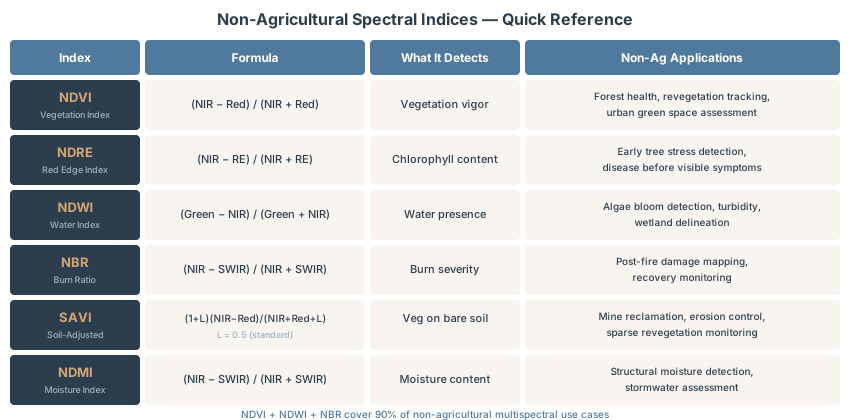
Here are the indices you’ll use most in non-agricultural drone work:
| Index | Formula | What It Detects | Non-Ag Applications |
|---|---|---|---|
| NDVI | (NIR − Red) / (NIR + Red) | Vegetation vigor | Forest health, revegetation tracking, urban green space inventory |
| NDRE | (NIR − Red Edge) / (NIR + Red Edge) | Chlorophyll content | Early tree stress, disease detection before visible symptoms appear |
| NDWI | (Green − NIR) / (Green + NIR) | Water presence and extent | Algae bloom detection, turbidity mapping, wetland delineation |
| NBR | (NIR − SWIR) / (NIR + SWIR) | Burn severity | Post-fire damage assessment, recovery monitoring over weeks/months |
| SAVI | (1 + L)(NIR − Red) / (NIR + Red + L) | Vegetation on bare soil | Mine reclamation progress, erosion control, sparse revegetation tracking |
| NDMI | (NIR − SWIR) / (NIR + SWIR) | Moisture content | Structural water infiltration, stormwater detention pond assessment |
Each isolates a specific feature. Here’s how they apply outside agriculture.
Environmental Monitoring: Water Quality and Wetland Delineation
Traditional water quality monitoring relies on boat sampling. Visit a lake or river, collect samples, send them to a lab, wait for results. It’s slow, captures only one location at a time, and misses spatial patterns across the water body.
Multispectral drones change the equation. The University of New Hampshire tested UAV multispectral sensors on freshwater lakes for cyanobacteria blooms—toxic algal growth that kills livestock and sickens humans. Detection effectiveness: over 90%. Data collection and processing took 4.5 times less time than traditional sampling. The key index is the Normalized Chlorophyll Index (NDCI), which combines red, red edge, and NIR bands to isolate chlorophyll concentration even in diffuse blooms.
Accuracy drops in highly turbid water or extremely concentrated blooms. But for detecting bloom presence and extent before it densifies, multispectral beats traditional sampling on speed and cost.
Wetland delineation—mapping the boundary between water and land—relies on NIR data. Water absorbs NIR almost completely, appearing black. Land reflects NIR, appearing bright. That boundary is sharp. Combined with LiDAR elevation data, multispectral reaches high classification accuracy using Random Forest models. You map physically inaccessible wetlands without wading through them. Regulatory acceptance is strong—federal wetland work increasingly includes drone data.
For invasive aquatic species (water hyacinth, hydrilla, purple loosestrife), deep learning models achieve precision of 0.972 and intersection-over-union of 0.947. Multispectral reveals unique spectral signatures that distinguish invasive plants from native vegetation—impossible in RGB imagery alone.
Wildfire Assessment and Recovery
A wildfire burns 1,000 acres. You need burn severity assessment without sending teams into hazard zones. You need to know which areas burned hot, which survived, and where recovery is fastest.
Multispectral drones handle this faster and safer than ground surveys. The primary index is Normalized Burn Ratio (NBR), which uses NIR and SWIR bands:
NBR = (NIR − SWIR) / (NIR + SWIR)
Burned vegetation has low NIR reflectance and high SWIR reflectance—the opposite of healthy vegetation. NBR amplifies this difference. In practice, burn severity mapping uses dNBR (differenced NBR): pre-fire NBR minus post-fire NBR. High positive dNBR values indicate severe burn. Negative dNBR values indicate post-fire regrowth. The USGS classifies dNBR ranges as: >0.66 high severity, 0.44–0.66 moderate-high, 0.27–0.44 moderate-low, <0.1 unburned.
A MicaSense RedEdge-equipped UAS mapped a 7.2 km² (2.8 mi²) burn area the day after containment. Flight time: 35 minutes. Processing: 2 hours. Ground assessment would have taken weeks, exposing teams to unstable terrain, standing snags, and poor air quality.
Recovery monitoring tracks the same area over weeks and months. NDVI measures regrowth as the forest regenerates. NBR sensitivity decreases as vegetation regrows, so NDVI becomes your primary metric 2–3 months post-fire.
One caveat: NBR is most accurate immediately post-fire, when spectral contrast between burned and unburned areas is highest. As ash weathers and vegetation recovers, NBR sensitivity drops. This isn’t a method limitation—burn severity simply becomes harder to distinguish as the site changes. For initial damage assessment and recovery tracking, multispectral is the standard.
Construction and Infrastructure Inspection
Thermal imaging reveals what RGB cameras cannot see: temperature differences that indicate problems.
Building Envelope Inspection
A flat roof maintains uniform temperature. A roof with water infiltration shows cold spots—water conducts heat faster than dry insulation. Night flights reduce solar noise, making thermal anomalies obvious. A thermal drone collects 30 minutes of imagery and delivers a report highlighting problem areas. Crews target repairs instead of replacing the entire roof. A single inspection often pays for the equipment over 10–15 projects.
Solar Panel Inspection
Traditional I-V curve tracing requires a technician on the roof with meters, testing each string. Time: 2–5 hours per megawatt. A thermal drone inspects in roughly 10 minutes per megawatt. The camera reveals hotspots—cells or strings producing less current and burning excess voltage as heat. Hotspots indicate cell damage, bad soldering, or partial shading degrading output. Detection runs 5–25 times faster than manual work, and you cover an entire farm in a single flight.
Concrete Curing
Thermal imaging detects curing progress within 24–48 hours of placement. Fresh concrete generates heat as it hydrates. Cold spots indicate insufficient hydration; hot spots indicate excess reaction. A contractor adjusts curing protocols, adds heat, or holds concrete longer. This reduces rework and accelerates schedules.
Mining and Quarry Operations
Multispectral sensors identify minerals. VNIR (visible and near-infrared, 0.4–1.0 µm) identifies iron-bearing minerals. SWIR (shortwave infrared, 1.0–2.5 µm) detects carbonates, clays, and phyllosilicates. Combine this with photogrammetry-derived volumes to answer: “What material is in this stockpile and how much?”
Stockpile analysis: Fly the stockpile with RGB to get 3D model and volume in photogrammetry software. Fly again with multispectral, calculate mineral indices, classify pixels. Result: tonnage by material type. This precision drives sales, blend planning, and inventory management.
Reclamation monitoring tracks revegetation on mined land using NDVI (vegetation vigor), NDRE (chlorophyll content), and SAVI (sparse vegetation on bare soil). SAVI is designed for bare soil work, so it’s more sensitive at early reclamation stages. Regulatory acceptance is strong—the Office of Surface Mining Reclamation and Enforcement accepts drone data for SMCRA compliance. State regulators increasingly require multispectral documentation.
Forestry Management
Forests generate value through timber, carbon offsets, and ecosystem services. Multispectral monitoring quantifies all three.
Blue Normalized Difference Vegetation Index (BNDVI) detects physiological stress before visible symptoms appear. It’s more sensitive than standard NDVI because it isolates blue light reflectance, which shifts earlier in stressed vegetation. A forest manager spots unhealthy trees before insect outbreak or disease becomes visible, enabling early intervention.
Species classification requires more data. Random Forest models trained on multispectral data achieve roughly 78% accuracy for species classification. Deep learning on hyperspectral data (hundreds of narrow bands) achieves 96.2% accuracy but requires significantly more expensive sensors and processing. For operational forestry, multispectral is the pragmatic choice—78% accuracy works for stand-level inventory without the hyperspectral cost.
Canopy density mapping combines multispectral NDVI with LiDAR elevation data. NDVI shows horizontal vegetation extent; LiDAR shows vertical structure (canopy height, layering). The fusion reveals how much vegetation you have and where it sits vertically—critical for stand density, competition stress, and timber volume.
Post-harvest assessment guides reforestation planning. Red edge and NIR bands track recovery speed across cutover areas and identify zones requiring replanting versus zones recovering naturally.
Urban Planning and Green Infrastructure
City planners face one key problem: urban heat islands. Cities are 1–7°F warmer than surrounding areas due to pavement, buildings, and reduced vegetation. The solution involves planting trees, creating green roofs, and installing permeable surfaces. But you can only justify the investment if you quantify the problem.
Satellite thermal imagery has 30-meter resolution. A drone thermal image has 1.5-centimeter resolution. A satellite sees “average temperature in this block.” A drone sees which specific roofs are hot, which parking lots are hot, and which tree canopies are cooling the area. That precision drives targeted green infrastructure investment.
NDVI quantifies vegetation biomass in urban spaces. Object-based classification—grouping adjacent pixels with similar spectral properties—reaches 87% accuracy for separating trees, shrubs, grass, and pavement. Planners use this for tree-canopy reporting, biodiversity assessments, and stormwater planning.
Impervious surface mapping is trickier. Multispectral struggles to distinguish pavement from bare soil because both have similar reflectance. Hyperspectral data or radar (which uses texture, not reflectance) reduces this confusion. For most municipal work, the error margin is acceptable. For precision work, fusion with LiDAR or radar justifies the cost.
Stormwater infrastructure maps soil saturation using NDMI (Normalized Difference Moisture Index) and validates bioswale and rain garden health using NDVI. A municipality demonstrates that green infrastructure investments perform as designed—aesthetically and functionally.
Hardware: Which Sensor to Buy
You don’t need custom integration or a $50,000 system to start. Here are the options:
| System | Bands | Thermal | Price | Best For |
|---|---|---|---|---|
| DJI Mavic 3M | 4 (Green, Red, Red Edge, NIR) + 20 MP RGB | No | ~$5,700 | Entry-level professional multispectral; RTK built-in |
| Sentera 4K 5-Band | 5 bands (G, R, RE, NIR, NDVI) | No | $2,100 | Most affordable 5-band sensor; integrates on existing drones |
| MicaSense RedEdge-P | 5 bands + panchromatic | No | ~$8,395 (base kit) | High-accuracy professional surveys; research-grade |
| MicaSense Altum-PT | 5 bands + 12 MP panchromatic | Yes (320×256) | ~$15,495 | Thermal + multispectral in one sensor; premium option |
| Sentera 6X | 5 multispectral + RGB | No (base); 6X Thermal variant adds FLIR | $13,950 (base) | Professional multispectral; thermal variant available separately |
| Parrot Sequoia+ | 4 bands (R, G, RE, NIR) + 16 MP RGB | No | ~$2,000–$3,000 (limited stock) | Budget entry; aging platform but still capable |
For most non-ag work, the DJI Mavic 3M hits the sweet spot. RTK and PPK are built in (eliminating the need for GCPs in most applications). It includes a sunlight sensor for automatic radiometric calibration, making reflectance values comparable across flights. At ~$5,700, it’s professional-grade but accessible. The tradeoff: no thermal imaging built in.
If you need thermal: Sentera 6X Thermal or Altum-PT. The 6X Thermal variant adds FLIR to the base 6X multispectral sensor. The Altum-PT at ~$15,495 delivers 5-band multispectral and thermal in a single payload. Both mount on DJI Matrice or custom platforms. Thermal resolution works for building inspection but isn’t as detailed as dedicated thermal drones.
Budget entry: Sentera 4K 5-Band at $2,100. This is a sensor only—mount it on a DJI Phantom 4, Mavic 2, or custom frame. It captures 5 bands (the company pre-calculates NDVI in-flight). The tradeoff: no radiometric calibration, no built-in RTK. You’ll use GCPs for georeferencing. Good for learning; scaling up requires something more capable.
Parrot Sequoia+ is aging. Released in 2016, it has 4 multispectral bands plus 16 MP RGB. Stock is limited. Future firmware support is uncertain. Skip it unless you find a deep discount and accept limited updates.
Processing Software
Raw multispectral data doesn’t become a useful map on its own. You need software that handles multiple bands, calculates indices, and radiometrically corrects pixel values to reflect actual material reflectance (not camera sensor output).
Pix4Dmapper is the industry standard for professional surveys. It computes all indices, handles GCP-based georeferencing, and produces publication-quality orthomosaics. Subscription: $332.50/month or $399–$479.88/year annual (as of 2026-04-22); perpetual licensing is no longer advertised by Pix4D. Worth it if you process large areas regularly.
DJI Terra (free with Mavic 3M, or $1,500/year standalone) supports DJI multispectral drones. It calculates NDVI and NDRE, applies radiometric correction via sunlight sensor, and exports GeoTIFF results. Simple and functional for many applications, but limited to DJI data.
OpenDroneMap is free and open-source. Radiometric calibration: use --radiometric-calibration camera+sun flag (available since v0.9.9). Important: process all bands together in one folder—don’t separate them. The software assumes sequential band numbering in filenames. Output is GeoTIFF with reflectance-calibrated pixel values. Good for non-commercial work or proof-of-concept. Processing is slower than Pix4D but acceptable for small-to-medium projects.
QGIS Raster Calculator is free. Once you have GeoTIFFs, QGIS computes any index using band math. NDVI formula: (NIR - Red) / (NIR + Red). Create a new raster where each pixel is the calculation result. The QGIS Raster Indices plugin automates common indices. Not suitable for raw image processing (that needs photogrammetry software), but excellent for post-processing georeferenced data.
ArcGIS Pro offers robust band arithmetic and 160+ built-in raster functions. Image Analyst extension (additional cost) adds supervised classification, deep learning inference, and change detection. Enterprise-grade tool. Standard in organizations already licensing ArcGIS.
For non-agricultural work, Pix4Dmapper is the professional default because it handles radiometric needs and produces defensible deliverables. If budget is tight, OpenDroneMap covers 90% of use cases at zero cost.
FAQ: Non-Ag Multispectral Questions
Q: Do I need a dedicated multispectral drone or can I add a sensor to my existing platform?
Either works. A DJI Mavic 3M is a complete system—simplest approach, zero integration headaches. A MicaSense sensor mounts on a DJI Matrice or custom frame, giving you flexibility for different payloads (multispectral one day, thermal the next, RGB another time). Turnkey systems are simpler; add-on sensors offer more versatility.
Q: Which spectral index should I use for water quality monitoring?
Use NDWI for delineating water bodies and detecting open water extent. Use NDCI (Normalized Difference Chlorophyll Index) for algal bloom detection—it isolates chlorophyll concentration. Both require green and NIR bands; NDCI specifically needs red edge if available. Start with NDWI on 4-band sensors; upgrade to NDCI on 5+ band systems.
Q: Can I use multispectral data in QGIS?
Yes. Import bands as separate raster layers, then use Raster Calculator to compute indices. Formula: (layer_nir - layer_red) / (layer_nir + layer_red) produces NDVI. Output is a single-band raster. Free and effective for non-commercial work. For large-scale operations, Pix4Dmapper is faster and handles radiometric correction automatically.
Q: Do I need radiometric calibration panels?
Yes, for quantitative work. Calibration panels (white targets with known reflectance) normalize data across flights and lighting conditions. A Pix4D calibration panel (white, 50×50 cm) costs ~$300. Place it in your flight area, photograph it at mission start, and the software uses it to correct all pixel values. The DJI Mavic 3M has a built-in sunlight sensor that reduces panel need but doesn’t eliminate it. For maximum accuracy in time-series work (comparing this month to next month), use panels.
Q: What about hyperspectral vs multispectral?
Hyperspectral captures 100–400 narrow bands; multispectral captures 4–10 broad bands. Hyperspectral excels at mineral classification and species identification but costs significantly more (sensors: $50,000+), requires heavier platforms, and demands complex processing. Multispectral covers 90% of non-ag use cases. Use hyperspectral only when multispectral accuracy is insufficient—typically for advanced mineral mapping or high-precision species work.
Pricing Your Multispectral Services
Multispectral services command a premium in non-ag industries because the technology is rarer and the analysis is more specialized.
Small projects (<50 acres): $300–$5,000. Thermal building inspection is your smallest entry—one roof takes 20 minutes.
Medium projects (50–500 acres): $5,000–$15,000. Environmental assessment, mine reclamation monitoring, or forest health survey.
Large projects (500+ acres): $15,000–$50,000+. Regional wildfire assessment, multi-site water quality monitoring, or large mining operations.
Per-acre pricing: $5–$20 for RGB mapping. Add 15–25% premium for multispectral work due to sensor cost and analysis complexity.
Strongest ROI sectors:
- Thermal building inspection: 10–15 projects recover equipment cost.
- Solar farm monitoring: 5–25 times faster than manual I-V testing.
- Mine reclamation compliance: Regulatory requirement, guaranteed demand.
These three are your entry points. Once you have case studies, cross-sell into environmental monitoring and utilities.
Multispectral drones aren’t agriculture technology with side applications. They’re tools for seeing what RGB cameras fundamentally cannot. NDWI for water quality. NBR for wildfire. SAVI for revegetation. Thermal for building envelopes. The technology is identical, the sensor platform is standard, and the ROI is proven.
The DJI Mavic 3M at ~$5,700 puts professional multispectral within reach of any operation. The applications are broader than most operators realize, and the markets are less saturated than agricultural services. If you’ve built expertise in RGB mapping, multispectral is a logical adjacent revenue stream—same flying skills, different analysis.
Start with thermal building inspection or solar farm monitoring. Quick payback. Clear ROI. Existing demand. Once you have one application running, expand.
Cross-Links
- LiDAR vs Photogrammetry: When to Use Each
- Drone Survey Accuracy Explained
- QGIS for Drone Data: Complete Workflow
- Pix4D vs Metashape vs WebODM vs RealityCapture
- DSM vs DTM vs DEM Explained
- What Is an Orthomosaic?
- GSD Calculator Tool
- GCP Calculator Tool